
Every time you type a question into Google and get a list of results, there’s a hidden process working behind the scenes to decide what shows up first. That process is SEO search engine optimization and understanding how it works can be the difference between a website that gets found and one that stays invisible.
This guide explains how does SEO works, step by step, using plain language instead of jargon. By the end, you’ll understand not just the theory, but how to apply it to your own website.
What Is SEO, in Simple Terms?
SEO is the practice of improving a website so that search engines like Google can find it, understand it, and rank it higher for relevant searches. Unlike paid advertising, which stops working the moment you stop paying, SEO builds visibility that compounds over time the better your site gets, the more consistently it shows up in search results.
At its core, SEO aligns three things: what search engines can technically access on your site, what your content actually says, and how much other trusted sources vouch for you. Get all three right, and search engines reward you with higher rankings.
The 3-Step Process Search Engines Actually Follow.
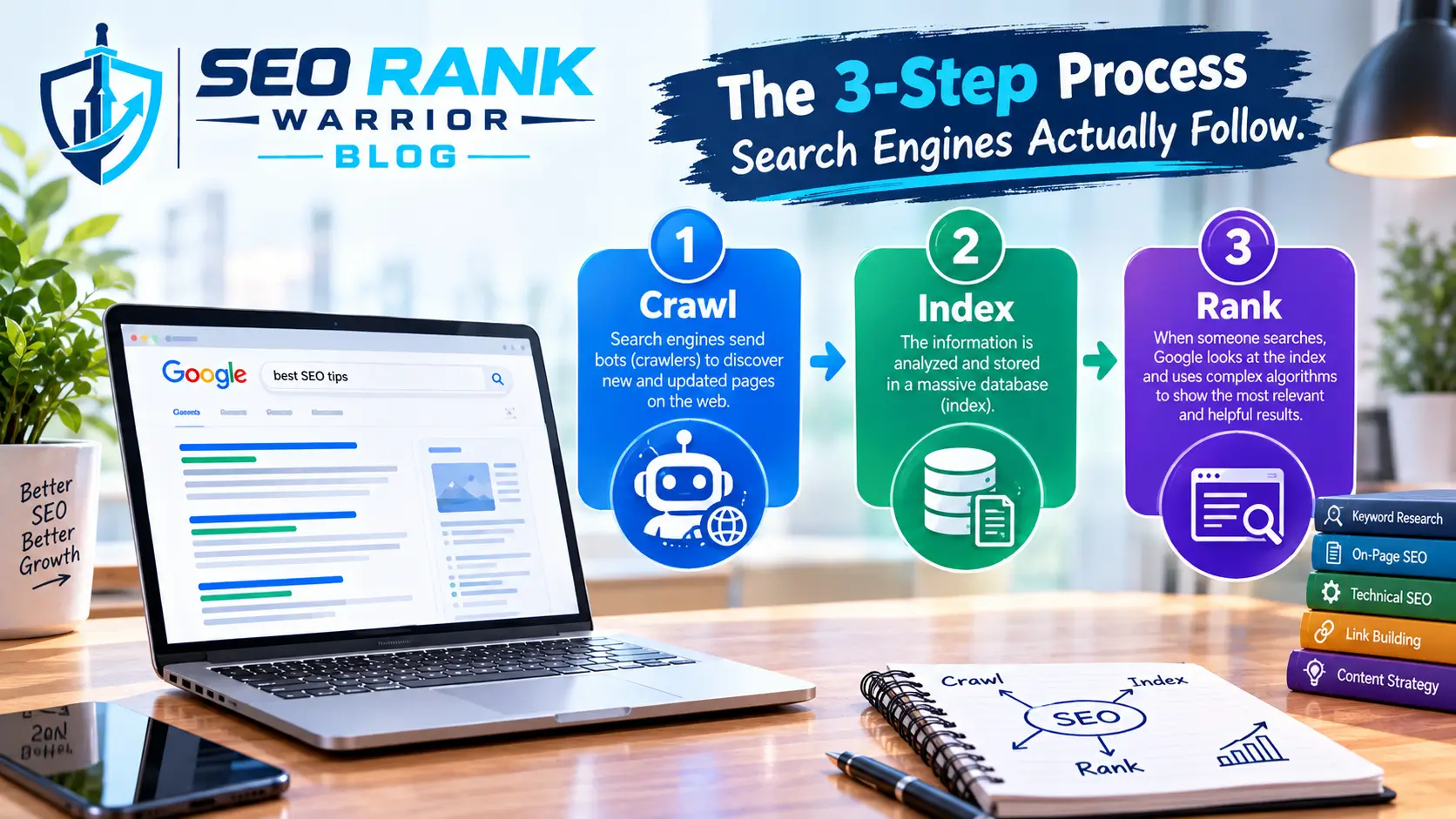
To understand how SEO works, you first need to understand what search engines do behind the scenes every time a new page goes live.
Step 1: Crawling
Search engines use automated programs called “crawlers” or “bots” (Google’s is called Googlebot) that travel across the web by following links from one page to another. Think of crawling like a librarian walking through every aisle of a library, checking what’s on every shelf. If your page isn’t linked from anywhere, or your site blocks crawlers through technical errors, it may never even be discovered.
Step 2: Indexing
Once a page is crawled, the search engine analyzes its content and decides whether to store it in its massive database, called the index. Only indexed pages are eligible to appear in search results. Pages with thin, duplicate, or low-value content are often left out of the index entirely meaning they can rank for nothing, no matter how good your keywords are.
Step 3: Ranking
When someone types a search query, the search engine scans its index and ranks the most relevant, trustworthy pages at the top. This ranking is decided using hundreds of signals including keyword relevance, content quality, page speed, mobile-friendliness, and how many other reputable sites link to the page.
Understanding this three-step flow is the foundation of SEO: your job isn’t just to write good content; it’s to make sure that content can be crawled, indexed, and seen as the best possible answer to a search query.
The Three Pillars of SEO
Once you understand how search engines process a website, SEO strategy breaks down into three core pillars.
On-Page SEO
This covers everything you control directly on your website: the words in your titles, headings, and body content, how naturally your target keywords are used, your meta descriptions, and how your images and internal links are structured. On-page SEO tells search engines exactly what a page is about and who it’s useful for.
Off-Page SEO
This is about building trust signals from outside your own website primarily through backlinks, which are links from other websites pointing to yours. When a reputable site links to your page, it acts like a vote of confidence. The more relevant, high-quality sites that link to you, the more authority your page earns in the eyes of search engines.
Technical SEO
This is the behind-the-scenes plumbing of your website: how fast it loads, whether it works well on mobile devices, whether your site structure is easy to navigate, and whether you’re using schema markup (structured data that helps search engines understand your content more precisely, and increasingly helps AI tools like ChatGPT and Google’s AI Overviews summarize your content accurately).
All three pillars need to work together. A site with brilliant content but a slow, broken structure will still struggle to rank and a technically perfect site with thin content won’t rank either.
The Ranking Factors That Matter Most
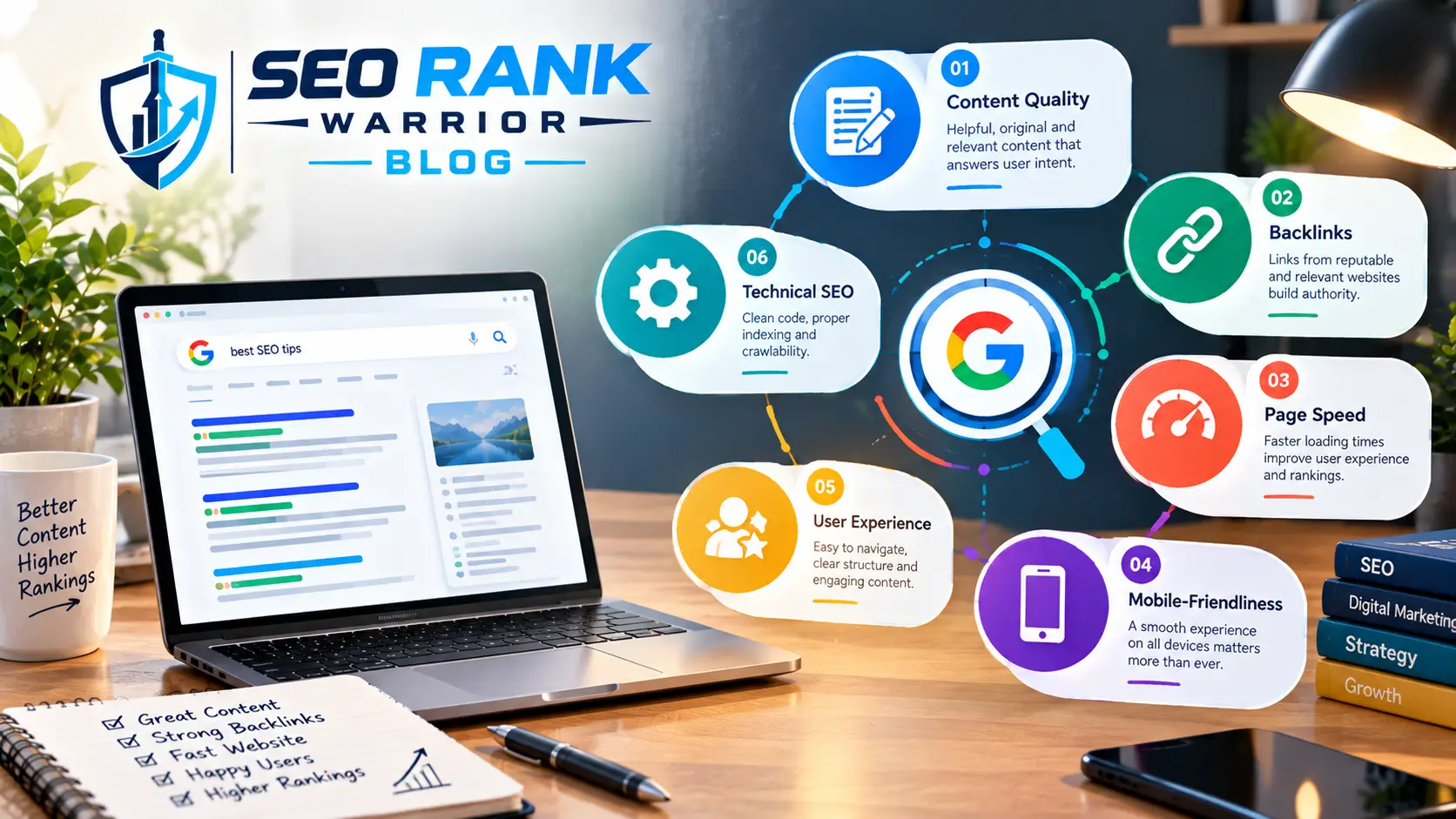
While search engines use hundreds of signals, a handful consistently make the biggest difference:
Search Intent Does your content actually answer what the searcher is looking for? Matching intent matters more than keyword density.
Content Quality and Depth Comprehensive, well-organized content that fully answers a question tends to outperform short, surface-level pages.
Backlinks from Relevant Sites Links from trustworthy, topically relevant websites still carry significant weight in rankings.
Page Experience Site speed, mobile usability, and clean navigation directly affect both rankings and how long visitors stay on your page.
E-E-A-T Signals Experience, Expertise, Authoritativeness, and Trustworthiness. Search engines increasingly reward content written by people with real, demonstrable knowledge of the topic.
How SEO Is Changing in the Age of AI Search
SEO no longer means optimizing for Google alone. Tools like AI Overviews, ChatGPT, and Perplexity now pull information directly from websites to generate summarized answers a shift often called Generative Engine Optimization (GEO) or AI Optimization (AIO).
To stay visible in this environment, content needs to be structured clearly with direct answers, well-organized headings, and factual accuracy, since AI tools tend to favor content that’s easy to extract and summarize. This makes clear formatting, FAQs, and concise explanations more important than ever, not just for human readers but for the AI systems increasingly standing between your content and your audience.
How Long Does SEO Take to Work?
SEO is not instant. Most websites start seeing measurable movement in rankings within three to six months, with more significant results building over six to twelve months. This timeline depends on your site’s current authority, how competitive your keywords are, and how consistently you publish and improve content. Unlike paid ads, though, SEO gains tend to compound a well-optimized page can keep driving traffic for years with minimal ongoing effort.
A Simple SEO Checklist to Get Started

- Research keywords that match real search intent, not just high search volume
- Write clear, in-depth content that fully answers the searcher’s question
- Use your primary keyword naturally in the title, headings, and first paragraph
- Ensure your site loads quickly and works well on mobile
- Add internal links between related pages on your site
- Earn backlinks by creating content worth referencing, not by buying links
- Use structured data (schema markup) where relevant
- Update and improve older content regularly rather than leaving it static
FAQs – How Does SEO Work?
How does SEO actually work in simple terms?
SEO works by helping search engines crawl, index, and rank your website based on how relevant, trustworthy, and well-structured your content is compared to other pages answering the same search query.
How long does it take to see results from SEO?
Most websites begin seeing noticeable ranking improvements within three to six months, though highly competitive keywords can take longer. Results tend to build gradually and compound over time.
What’s the difference between on-page and off-page SEO?
On-page SEO refers to elements you control directly on your website, like content and keywords. Off-page SEO refers to external trust signals, primarily backlinks from other websites.
Do I need backlinks for SEO to work?
Backlinks remain an important ranking factor, but they work best alongside strong content and solid technical SEO. Quality and relevance of links matter far more than quantity.
Is SEO still relevant with AI search tools like ChatGPT and Google AI Overviews?
Yes. AI search tools still pull their answers from indexed, well-structured web content, which means traditional SEO fundamentals combined with clear, well-organized formatting remain essential for visibility in AI-generated results.
Conclusion
SEO works by helping search engines find, understand, and trust your website enough to recommend it to searchers. It’s not a single trick or hack it’s the combination of technical accessibility, high-quality content, and credible signals from across the web, all working together over time.
The businesses and creators who succeed with SEO aren’t the ones chasing shortcuts; they’re the ones who consistently create genuinely useful content and make it easy for both search engines and AI tools to understand. Start with the fundamentals in this guide, stay consistent, and the results will follow.