
If you have ever wondered what the world looks like through your dog’s eyes, one of the biggest differences is color. Dogs do not see the same full range of colors that humans do, but the idea that dogs see everything in black and white is a myth. Their eyes are adapted to detect certain colors while also giving them useful abilities in low light and motion detection.
So, what colors can dogs see? Dogs have dichromatic vision, meaning their eyes have two types of color-sensing cone cells. They are especially good at distinguishing blue and yellow, while colors such as red and green are much harder for them to differentiate.
The Short Answer: What Colors Can Dogs See?
Dogs can see colors, but their color spectrum is narrower than ours.
Their vision is generally described as blue-yellow dichromatic vision. This means dogs can distinguish different shades in the blue and yellow ranges more effectively than colors such as red and green.
A simple way to think about it is that a dog’s visual world contains:
- Blue
- Yellow
- Some shades of gray
- Some shades that appear brownish or muted
Red, green, orange, and similar colors do not appear to dogs in the same way they appear to humans.
This does not mean these colors are completely invisible. Instead, dogs have difficulty distinguishing them from one another because their eyes lack the same type of color receptors humans have.
Why Is Dog Color Vision Different From Ours?
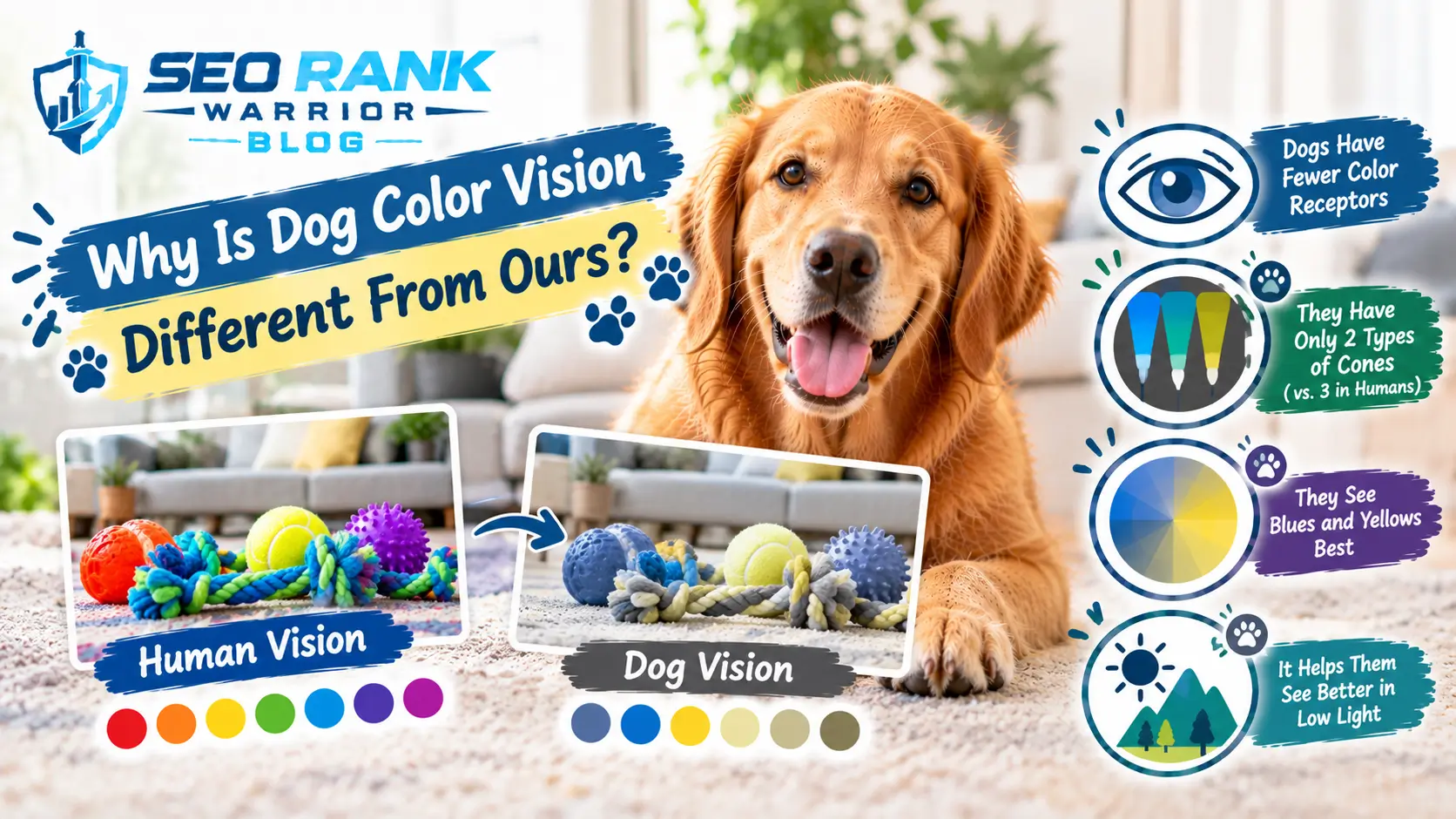
The difference begins inside the retina, the light-sensitive layer at the back of the eye.
Two important types of photoreceptors are rods and cones. Cones are involved in color perception, while rods are particularly important for detecting light levels and movement.
Humans normally have three types of cones, allowing us to perceive a much broader combination of colors. Dogs have two types of cones, which limits their ability to distinguish certain parts of the visible spectrum.
This is why canine vision is called dichromatic vision.
Dogs have also evolved visual characteristics that are useful for their lifestyle. Their eyes contain relatively more rods than human eyes, which helps them detect movement and function better in dim lighting.
Their vision is therefore not simply worse than human vision. It is different and adapted for different purposes.
Are Dogs Color Blind?
Dogs are often described as color blind, but that phrase can be misleading.
Dogs are not completely color blind and do not live in a black-and-white world. Their normal vision is more comparable to red-green color blindness in humans because both involve difficulty distinguishing certain red and green hues.
A dog can still recognize differences in color, brightness, and contrast. The important distinction is that its color range is narrower than a human’s.
For example, a person may clearly distinguish a red ball from a green ball based largely on color. A dog may have a much harder time separating those same colors, particularly when the objects have similar brightness and are placed against a background with little contrast.
What Does Red Look Like to a Dog?
Red is one of the colors dogs have difficulty distinguishing.
Instead of seeing a bright red object the way a human does, a dog may perceive it as a darker, muted, or brownish-looking shade.
The exact appearance cannot be described with complete certainty because we cannot directly experience another animal’s visual perception. Scientists use anatomical research and behavioral experiments to understand how dogs respond to different wavelengths.
This is why saying that dogs see red as one exact color can be an oversimplification.
What matters practically is that red objects may not stand out to dogs as strongly as they do to humans.
Can Dogs See Green?
Dogs cannot distinguish green the way humans normally can.
Depending on the particular shade and surrounding colors, green may appear less saturated and may blend with other muted tones. This becomes especially important when a green object is placed on grass.
For example, imagine throwing a red or orange ball across a green lawn. A human may immediately notice the ball because its color contrasts strongly with the grass. Your dog may have less visual contrast between the object and its surroundings.
This is one reason color alone should not be used to judge how easily a dog can find an object.
Brightness, movement, shape, smell, and contrast can all contribute to how noticeable something is.
What About Blue and Yellow?
Blue and yellow are generally the most useful colors to consider when choosing objects for dogs.
Dogs are particularly good at distinguishing shades within these color ranges. A blue or yellow toy can therefore provide stronger color contrast than a red or green toy in many situations.
This does not mean every blue or yellow object will automatically be easy for your dog to find. Background and lighting still matter.
A bright yellow toy on a pale surface may not provide much contrast, while a blue toy against green grass may be much easier to notice.
The combination of color plus contrast is often more important than color by itself.
Can Dogs See Orange and Purple?
Dogs do not perceive orange and purple in the same way humans do.
Orange contains wavelengths that dogs do not separate in the same way our three-cone visual system does. Depending on the shade, it may appear closer to a yellowish or muted tone.
Purple presents another interesting example because it contains components that can be perceived within the blue range. To a dog, purple may therefore appear more like a shade of blue than the rich purple humans see.
The exact appearance varies with brightness and the surrounding environment, so these comparisons should be treated as useful approximations rather than exact translations of canine vision.
Do Dogs See Black and White?
Yes, dogs can distinguish black, white, and different levels of brightness.
However, they do not see only black and white.
The old idea that dogs see the entire world as a grayscale movie is inaccurate. Their eyes can distinguish blue and yellow hues, along with differences in brightness and contrast.
In some situations, a dog may rely more heavily on brightness and contrast than color. This can be especially useful when lighting is poor or when an object is moving.
How Is Dog Vision Different From Human Vision?
Human and canine vision differ in several important ways.
| Feature | Humans | Dogs |
| Color vision | Three cone types | Two cone types |
| Color range | Broader | More limited |
| Main visible colors | Broad spectrum | Especially blue and yellow |
| Motion detection | Good | Highly developed |
| Low-light vision | Limited compared with dogs | Better adapted |
| Color discrimination | More detailed | More limited |
Humans generally have an advantage when it comes to distinguishing a broad range of colors and fine visual details.
Dogs, on the other hand, have visual adaptations that help them detect movement and see in lower-light conditions.
This difference makes sense when you consider how canine vision developed. Detecting movement and navigating changing light conditions can be extremely useful for animals that are active around dawn, dusk, or in other relatively dim environments.
Why Can Dogs See Better in Low Light?
Color vision is only one part of eyesight.
Dogs have more rod photoreceptors relative to cones than humans. Rods are highly sensitive to light and play an important role in detecting movement and seeing in dim conditions.
Dogs also have a structure called the tapetum lucidum, a reflective layer behind the retina that helps redirect available light through the retina. This contributes to their ability to see in lower-light environments and is also responsible for the noticeable eye shine you may see when light hits a dog’s eyes at night.
This does not mean dogs can see in complete darkness. They still need some available light.
Their advantage is that their eyes are better adapted to making use of limited light than human eyes.
Do Dogs See Movement Better Than Color?
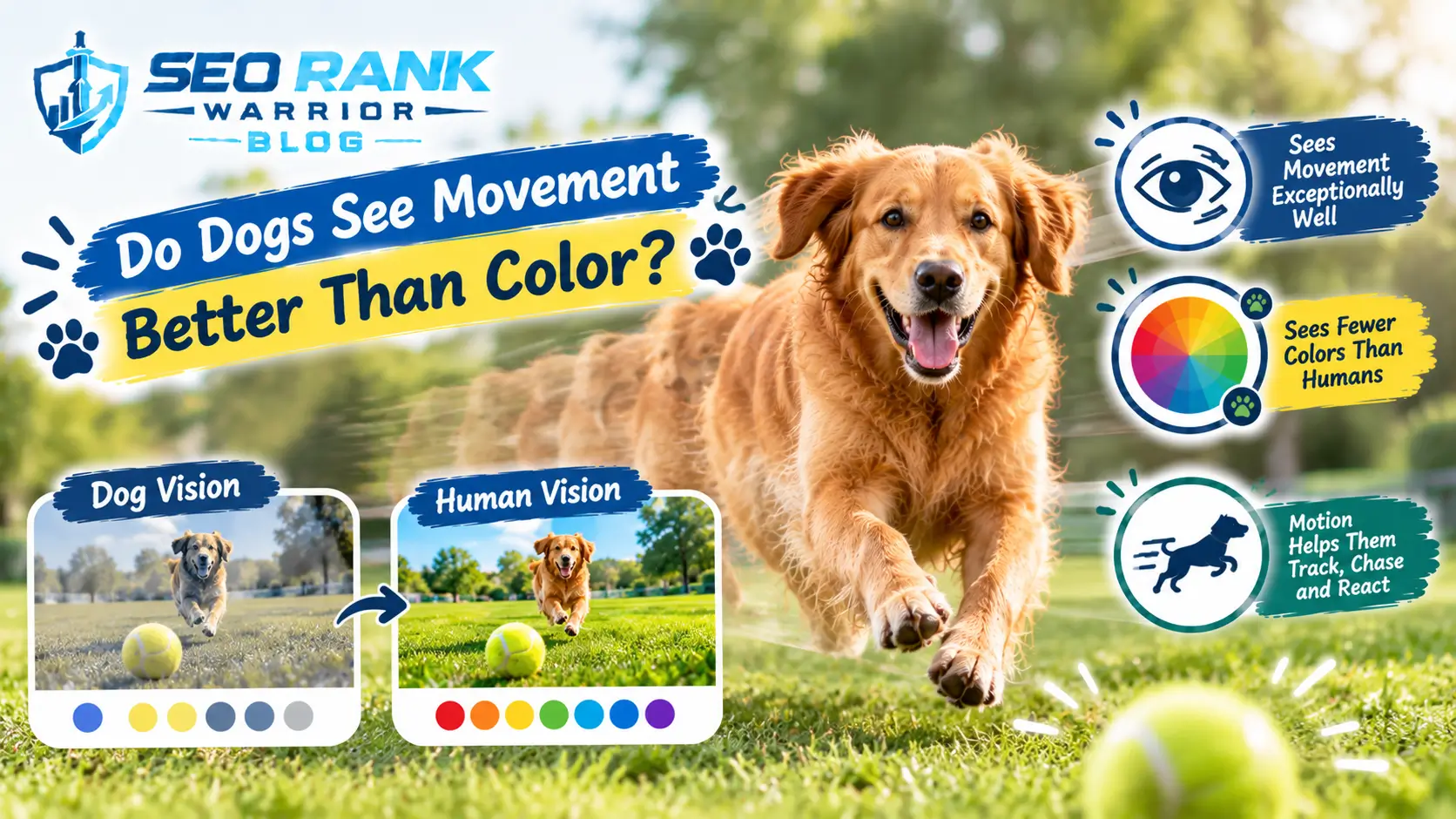
Movement can be extremely important to a dog’s visual perception.
A moving object may attract a dog’s attention even when its color is difficult to distinguish. This is one reason dogs can quickly notice a person, animal, toy, or object moving across their field of view.
Their strong motion sensitivity works alongside their other senses.
Dogs also rely heavily on smell and hearing, so vision is only one part of how they understand their environment.
This explains why a dog may find a toy using movement or scent even when its color does not stand out visually.
What Color Toys Are Best for Dogs?
If you are choosing toys specifically with canine vision in mind, blue and yellow are practical choices.
These colors are generally easier for dogs to distinguish than red or green.
For outdoor play, however, consider the background as well. A toy should ideally have strong contrast with the surface where you are using it.
For example:
- Blue toys can stand out against many green outdoor backgrounds.
- Yellow toys can also provide useful contrast.
- Red toys may be harder to distinguish from grass.
- Green toys may blend into lawns or vegetation.
- A bright color is not necessarily useful if it closely matches the background.
Movement can make a toy easier to notice as well.
When playing fetch, throwing a high-contrast toy can make it easier for your dog to visually track.
Does Color Matter During Dog Training?
Color can sometimes be useful during training, particularly when your dog is learning to distinguish between objects.
If you use visual cues, choosing colors that dogs can distinguish more easily may reduce unnecessary confusion.
For example, blue and yellow objects can be useful when teaching a dog to differentiate between two items.
However, dogs do not rely on color alone. Shape, position, smell, texture, movement, and learned associations can all help them identify an object.
A dog can learn to retrieve a red toy, for example. That does not mean the dog sees red exactly as a human does. It may recognize the toy because of its shape, location, smell, texture, or the particular visual shade it presents.
Why Does My Dog Find Some Toys Easier Than Others?
If your dog ignores one toy but immediately finds another, color may be part of the explanation, but it is rarely the only factor.
Consider these variables:
Background: A toy that blends into grass, carpet, or furniture can be difficult to spot.
Lighting: A color that is easy to distinguish in bright daylight may look different in low light.
Movement: Moving toys are often easier for dogs to notice.
Contrast: Strong differences between the toy and its surroundings can make an object more visually obvious.
Smell: Dogs have an extraordinary sense of smell and may identify familiar objects through scent.
Experience: Dogs learn to recognize objects through repeated interaction.
Therefore, if your dog struggles to find a particular toy, changing its color or using a higher-contrast object may help.
Can Dogs See TV, Phones, and Screens?
Yes, dogs can see images on modern screens.
The important question is not whether dogs can see a screen at all, but how they interpret what appears on it.
Because dogs have different color vision and visual processing from humans, images may not look the same to them. Motion can also be particularly noticeable.
Some dogs show interest in television programs or videos featuring animals and moving objects. Their response varies from dog to dog.
If your dog enjoys watching a screen, it does not necessarily mean they see it exactly as you do.
Can Dogs See in Complete Darkness?
No.
Dogs have better low-light vision than humans, but they still require some light to see.
Their greater number of rod cells, larger pupils, and other eye adaptations help them make better use of limited light. The tapetum lucidum also contributes to their low-light vision.
This is why your dog may appear comfortable moving around in dim conditions while you struggle to see clearly.
Even so, complete darkness is different from low light. In a completely dark environment, neither humans nor dogs can use ordinary vision normally.
Does a Dog’s Breed Affect Its Vision?
Breed can influence aspects of a dog’s visual field and eye structure.
Dogs have different skull and facial shapes, and the position of the eyes can affect peripheral and binocular vision. Some breeds have eyes positioned more toward the sides of the head, while others have more forward-facing eyes.
Individual dogs can also develop eye conditions that affect their vision.
So while the basic principles of canine color vision apply broadly to dogs, their overall visual experience is not necessarily identical across every breed or individual.
How Can You Make Your Home More Dog-Friendly for Vision?
You do not need to redesign your entire home around your dog’s color vision.
A few simple choices can make visual tasks easier:
- Use blue or yellow toys when possible.
- Choose toys that contrast with the floor or grass.
- Keep frequently used objects in consistent locations.
- Use movement during games such as fetch.
- Avoid assuming that a bright red object will automatically be easy for your dog to see.
- Keep pathways clear, especially for older dogs with changing eyesight.
These small adjustments can be especially useful when playing games or training your dog.
What If Your Dog’s Vision Seems to Be Changing?
Normal differences in canine vision are not the same as vision loss.
If your dog suddenly bumps into furniture, hesitates on stairs, struggles to find familiar objects, develops cloudy eyes, shows unusual pupil changes, or appears reluctant to move through familiar spaces, contact your veterinarian.
Vision changes can have many possible causes, and early veterinary assessment may be important.
An eye problem should not be assumed to be simply a result of your dog’s normal color vision.
FAQs – What Colors Can Dogs See?
What colors can dogs see best?
Dogs generally distinguish blue and yellow most effectively. Their ability to separate colors such as red and green is much more limited than ours.
Are dogs completely color blind?
No. Dogs are not limited to black-and-white vision. They have dichromatic color vision and can distinguish certain colors, particularly blue and yellow.
Can dogs see red?
Dogs can detect red light, but they do not perceive red in the same way humans do. Red objects may appear muted or blend more easily with their surroundings.
What is the best color for a dog toy?
Blue and yellow are generally useful choices because dogs can distinguish these colors more easily. Contrast with the background is also important, especially for outdoor toys.
Do dogs see better at night than humans?
Dogs generally perform better than humans in low-light conditions because their eyes contain more rod photoreceptors and have other adaptations that help them use available light. They cannot see in complete darkness.
Conclusion
So, what colors can dogs see? Dogs do see color, but their visual spectrum is narrower than the human spectrum. Their dichromatic vision allows them to distinguish blue and yellow particularly well, while red, green, orange, and similar colors are more difficult for them to separate.
Canine eyesight is not simply a weaker version of human eyesight. Dogs have developed visual abilities that support motion detection and low-light vision, while their powerful sense of smell and hearing provide additional ways to understand their surroundings.
Knowing how dogs see can also help you make practical choices. Blue or yellow toys, strong visual contrast, and moving objects can make play and training easier to follow. At the same time, sudden changes in your dog’s vision should always be taken seriously and discussed with a veterinarian.