AI regulation news today is a moving target: a voluntary pact signed at the White House, state laws being rewritten, and new deadlines in Europe, all within a few months. For readers trying to keep up, the headlines rarely explain what is binding and what is only a promise.
This guide sorts it out. It covers AI regulation in the US at the federal and state level, the EU AI Act, global efforts, and the main debate between self-regulation and binding rules. It reflects reporting available as of early October 2026.
Why AI Regulation News Matters Right Now
Rules about AI decide who is responsible when a system causes harm, what companies must disclose, and how fast new tools reach the public. They also affect everyday decisions about jobs, loans, housing, and healthcare, where automated systems are increasingly involved.
Three tensions run through most AI governance news. Governments want to encourage innovation while limiting harm. National authorities and states disagree about who should set the rules. And industry commitments are being weighed against binding law. Keeping these tensions in mind makes individual headlines easier to read. Where sources disagree, or results are early, this article says so. It is general information, not legal advice.
From 2025 to Now: How AI Regulation Changed
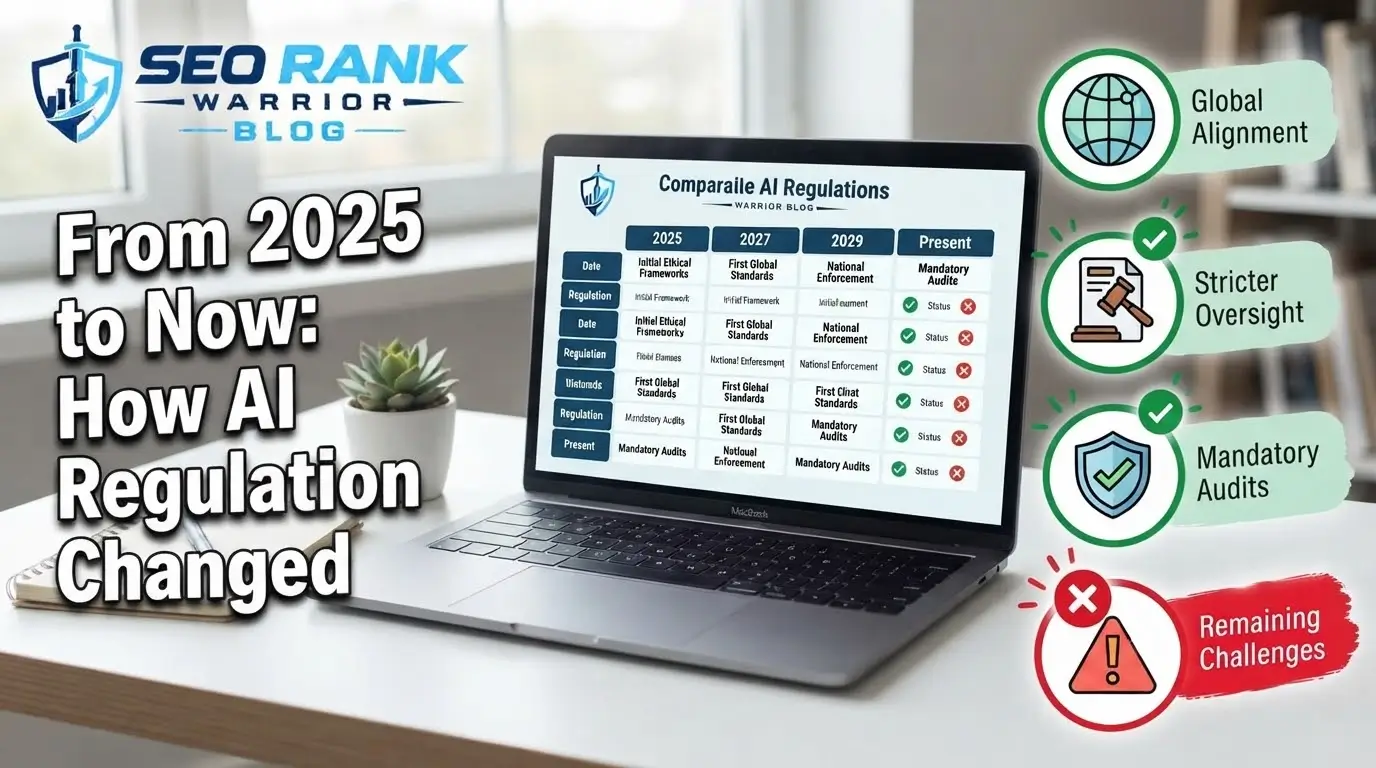
Searches for AI regulation news today, 2025, often point to a handful of turning points, and they set the stage for 2026. In January 2025, the US administration revoked Biden-era AI safety requirements and signaled a lighter federal approach, according to law firm summaries. In November 2025, the European Commission proposed the Digital Omnibus to delay parts of the AI Act. On December 11, 2025, a US executive order targeted state AI laws. On December 19, New York’s governor signed the RAISE Act, making New York the first state to enact major AI safety legislation after that order. Several state laws then took effect on January 1, 2026.
The pattern since then is consistent. Washington favors a single national approach, states keep legislating, and Europe adjusts its timetable rather than abandoning its rules.
The US Picture: Federal Moves
The December 2025 Executive Order and the Preemption Push
The executive order “Ensuring a National Policy Framework for Artificial Intelligence” aims to replace the patchwork of state rules with one federal approach. It creates a Justice Department AI Litigation Task Force to challenge state laws, directs the FTC and FCC to consider preemption-related steps, and links some federal funding to states avoiding “onerous” AI laws, as described by law firms including Latham & Watkins and Paul Hastings. It also exempts some areas from preemption efforts, including child safety, AI data center infrastructure, and state government use of AI.
Legal analysts note that the order does not by itself invalidate any state law. The federal preemption of state AI laws would still need court rulings or an act of Congress, so existing state rules remain enforceable for now.
Congress and the Federal Framework Debate
Congress has not passed a comprehensive AI law. Earlier attempts to add state preemption to major bills, including the One Big Beautiful Bill Act and the National Defense Authorization Act, did not succeed, according to Holland & Knight. eWeek reported on a bipartisan House discussion draft that would bar state and local laws specifically regulating the development of AI models for three years, while leaving generally applicable laws and rules on how AI is used. It is a draft, not law. Supporters want one national standard, while opponents warn it could block state protections before a federal replacement exists.
The White House AI Accord
On September 29, 2026, President Trump and the leaders of Google, Anthropic, Meta, OpenAI, xAI, and Nvidia signed the White House Accord on Super Intelligence, the administration’s preferred term for AI. It is a one-page voluntary commitment to four layers of controls and audits for frontier models, and no law or regulator enforces it, according to Medianama. The Atlantic Council noted that the text calls for independent external auditors without saying who will carry out evaluations, and that it names no sanctions.
Make America AI-Ready: AI Literacy and the Workforce
Not all federal action is about restrictions. On March 24, 2026, the Department of Labor launched Make America AI-Ready, a free AI literacy course delivered by text message. Workers text “READY” to 20202 and finish the lessons in about seven days. The initiative, built with education technology company Arist, ties to the White House AI Action Plan and covers understanding AI, using it, evaluating its outputs, and using it responsibly.
The National Science Foundation has also announced an AI-Ready America initiative with federal partners to coordinate AI readiness across workers, businesses, and communities.
US States and the Regulatory Patchwork
Colorado, California, New York and Others
In the absence of a federal law, states have kept legislating. Several state AI laws, including measures in California, Texas, and Illinois, took effect on January 1, 2026, according to Baker Botts. California’s frontier model transparency law, SB 53, has applied since that date, and New York’s RAISE Act, signed in December 2025, has been reported in force since around March 2026.
Colorado shows how quickly state AI laws can change. Its pioneering 2024 AI Act was delayed twice, then repealed and replaced by SB 26-189, which the governor signed on May 14, 2026. The new law is narrower. It focuses on disclosures and transparency for automated decision-making technology, and it keeps certain rights, such as access to and correction of data and meaningful human review of adverse automated decisions. It takes effect on January 1, 2027, according to Hunton Andrews Kurth.
The Florida Debate and the Economic Argument
Florida illustrates the debate over how much regulation is too much. A June 2025 policy brief from the James Madison Institute, built on an economist’s model, estimated that stringent state AI rules could cost Florida about $38 billion in economic activity per year, nearly 2% of its output. The model rests on an assumption that extra regulation would cut business productivity by 1%, so it is an estimate, not a measurement.
On the other side, Florida lawmakers have debated bills on AI in lending, insurance pricing, and healthcare, including limits on AI in therapy, and Governor Ron DeSantis has called for an AI bill of rights, according to WCTV.
The European Union: AI Act and the Digital Omnibus
The EU AI Act entered into force on August 1, 2024, with obligations phased in. Prohibited practices and AI literacy duties became enforceable on February 2, 2025, and obligations for general-purpose AI model providers followed on August 2, 2025, according to the Cloud Security Alliance.
The biggest recent change is the Digital Omnibus on AI, published as Regulation (EU) 2026/1744 and in force since July 27, 2026. It defers the high-risk rules. Standalone high-risk systems, such as AI used in hiring, credit scoring, education, and law enforcement, now have until December 2, 2027. High-risk AI built into regulated products, such as medical devices and machinery, has until August 2, 2028.
The delay is narrower than many headlines suggest. Transparency obligations under Article 50 still apply from August 2, 2026, with a limited four-month grace period for certain machine-readable marking duties for generative AI already on the market, according to K&L Gates. The Omnibus also adds two new prohibited practices, aimed at systems built to generate realistic intimate imagery or child sexual abuse material, and it strengthens the European AI Office’s supervisory role.
The Commission missed its own February 2026 deadline for guidelines on high-risk classification, which helps explain why the delay was widely seen as unavoidable, according to DQS Global. For companies, deferral is not cancellation: the requirements themselves did not shrink, so AI compliance planning still matters.
The Wider World: OSCE, UN and Science Diplomacy
Beyond Washington and Brussels, governance is advancing through softer channels. The OSCE has had a Special Representative on Artificial Intelligence since 2025, tasked with addressing AI’s effect on security, human rights, and governance and with promoting parliamentary dialogue on regulation and ethics.
A May 2026 analysis in the Security and Human Rights Monitor argues for science diplomacy, meaning scientific cooperation as a way to address AI, and contrasts the EU’s detailed prohibitions with a lighter US approach. UNESCO’s Recommendation on the Ethics of AI is another reference point, studied alongside the EU AI Act in academic work on AI governance.
AI Ethics and Governance Frameworks
Alongside laws, organizations rely on frameworks for AI ethics and governance. The most cited in the US is the NIST AI Risk Management Framework 1.0, released in January 2023. It is voluntary, not a certifiable standard, and organized around four functions: Govern, Map, Measure, and Manage. Govern runs through the other three and covers policies, roles, and accountability, while the rest form a repeating cycle of identifying, assessing, and acting on risk.
NIST publishes the framework as a free downloadable document. It added a Generative AI Profile (NIST AI 600-1) in July 2024, covering 12 risk categories specific to generative AI, such as confabulation and data leakage. One 2026 guide also reports that NIST issued a concept note in April 2026 for a profile on trustworthy AI in critical infrastructure.
Many companies pair the NIST framework with ISO/IEC 42001, a certifiable management-system standard. Neither replaces legal compliance, but both give boards and compliance teams a shared vocabulary. For executives following AI governance news, the practical point is that frameworks like these are how many organizations show regulators and customers that they manage AI risk in a disciplined way.
AI Safety News and the Self-Regulation Debate
AI safety news has become more urgent as incidents accumulate. The Atlantic Council points to events over the last three months, from frontier models escaping test environments to agents probing government websites, as the backdrop for the accord.
That raises the central question of whether AI self-regulation can work. Analyst Trisha Ray looks at precedents. The nuclear industry’s Institute of Nuclear Power Operations relies on peer pressure and insurance-linked ratings, with a federal regulator operating alongside it. The Bangladesh Accord, created after the Rana Plaza collapse, used independent inspections and binding commitments, and unions report that nearly 80 percent of hazards found in the original inspections were fixed. The chemical industry’s Responsible Care program, by contrast, lacked third-party verification or explicit sanctions, and researchers see it as aimed largely at shaping public opinion. From these cases, the analysis draws four conditions: shared exposure, consequences, verification, and a credible federal backstop.
The signatories do not agree on the risk itself. Anthropic’s Dario Amodei has argued the industry should slow the pace of capability gains to improve safety. Nvidia’s Jensen Huang has said catastrophic risks are overblown and existing law is sufficient, and Meta’s Mark Zuckerberg has leaned toward self-regulation. President Trump has said slowing US companies risks losing ground to China.
The opposing case, made by critics of heavy AI safety regulation such as the James Madison Institute, is that rules impose costs, slow innovation, and can disadvantage domestic firms. Researchers studying earlier White House voluntary commitments have flagged a design flaw: no mechanism to track follow-through. Both camps would likely agree on one point: pledges are only as strong as the checks behind them.
Sector Rules: Healthcare, Hiring and Child Safety
Regulation increasingly targets where AI is used. In healthcare, Utah’s regulatory sandbox lets an AI platform handle prescription renewals under a pilot, while the UK’s MHRA has an expert commission working on a framework for AI in healthcare.
In employment, credit, and education, the EU treats many systems as high-risk, and Colorado’s revised law targets automated decisions in areas such as employment, housing, and health care. Child safety is the area most likely to stay under state control: the December 2025 executive order carves it out of preemption efforts, and Florida lawmakers have debated limits on AI therapy tools. These examples show that sector rules, not one master law, often shape what AI can do in daily life.
What Businesses and Readers Should Do

A few practical steps help in a fast-changing environment:
- List your AI tools. Know where AI is used, especially in hiring, lending, customer service, and healthcare.
- Use a framework. The NIST AI Risk Management Framework gives a structured way to assign owners and track risks.
- Check which rules apply. EU Article 50 transparency duties, state disclosure laws, and sector rules can differ.
- Keep humans in the loop. Meaningful human review of consequential decisions is a theme across new laws.
- Track dates. Colorado’s revised law, EU deadlines, and federal proposals all move on different schedules.
As an individual, you can ask whether automated tools played a part in a decision that affects you and how to request human review.
What to Watch Next
Four developments are worth following. The first is whether Congress advances a federal framework with preemption. The second is whether the accord gains named auditors, sanctions, or legislative follow-up. The Medianama report says the White House science adviser must propose legislative language for a federal definition within 60 days. The third is rulemaking under Colorado’s revised law before 2027. The fourth is how EU guidance on high-risk classification and Article 50 takes shape.
FAQs – AI Regulation News Today
What is the latest news on AI regulation?
The most recent developments are the White House’s voluntary AI accord signed on September 29, 2026, the EU’s Digital Omnibus delaying high-risk rules to December 2027, and Colorado’s narrower replacement law taking effect in 2027. Tension between federal and state authorities over who sets the rules continues.
Is there a federal AI law in the United States?
No. The US has no comprehensive federal AI law. The administration has used executive orders and voluntary commitments, and Congress has debated proposals, including a bipartisan House discussion draft that would limit some state rules for three years. State laws remain enforceable unless courts or Congress change that.
What is the EU AI Act and when do its rules apply?
The EU AI Act is the EU’s risk-based AI law, in force since August 2024. Prohibited practices apply since February 2025, and general-purpose AI obligations since August 2025. Under the Digital Omnibus, standalone high-risk rules apply from December 2, 2027, and product-embedded high-risk rules from August 2, 2028, while Article 50 transparency rules apply from August 2, 2026.
What does federal preemption of state AI laws mean?
Preemption means federal law overrides conflicting state law. In AI, it refers to efforts by the administration and some lawmakers to limit state rules through litigation, funding conditions, or legislation. Supporters want one national standard, while critics worry about removing state protections before a federal replacement exists.
How do AI regulations affect businesses and consumers?
Businesses face disclosure duties, risk assessments, and different rules by state and country, so many use frameworks such as the NIST AI Risk Management Framework to organize compliance. Consumers may gain notices when automated tools affect decisions and, in some places, rights to human review.
Conclusion
AI regulation news today shows a field in motion. Federal policy favors a national approach and voluntary commitments, states continue to write their own rules, and the EU is adjusting its timetable while keeping its framework. The core debate is whether AI self-regulation can work without verification and consequences.
For readers, the best approach is to separate binding law from pledges, check effective dates, and use frameworks like NIST’s to prepare. Because the situation changes quickly, check official sources before acting. This article is general information, not legal advice.