
AI may seem completely digital, but behind every chatbot response, image, or AI-generated answer is a physical system running in a data center. These facilities use electricity, generate heat, and often rely on cooling systems that consume water. So, how much water does AI use? The answer is more complicated than the viral claim that every AI question “uses a bottle of water.”
The actual amount depends on the AI model, type of task, data-center location, cooling technology, and how water use is measured. In this article, we’ll break down where AI’s water footprint comes from, how much water a single AI query may use, why estimates vary, and why the bigger concern is the rapid growth of AI data centers.
How Much Water Does AI Use?
There is no single number that represents the water consumption of every AI query. Some recent estimates put the water use of a typical text prompt at less than one milliliter, while other studies have produced much higher numbers because they include additional parts of the AI infrastructure.
For example, Google estimated that a median Gemini text prompt consumed about 0.26 milliliters of water based on its May 2025 operational data. That is roughly a few drops of water, not a full bottle.
However, this should not be treated as a universal number for all AI systems. Different models and data centers operate under very different conditions.
What affects AI water consumption?
The amount of water associated with an AI request can change based on:
- The size and type of AI model
- The length and complexity of the request
- Whether the task is text, image, video, or reasoning-based
- The location of the data center
- The cooling system being used
- The source of electricity
- Whether direct or indirect water use is included
This is why two studies can examine “AI water use” and still come up with very different results.
Why Does AI Use Water?
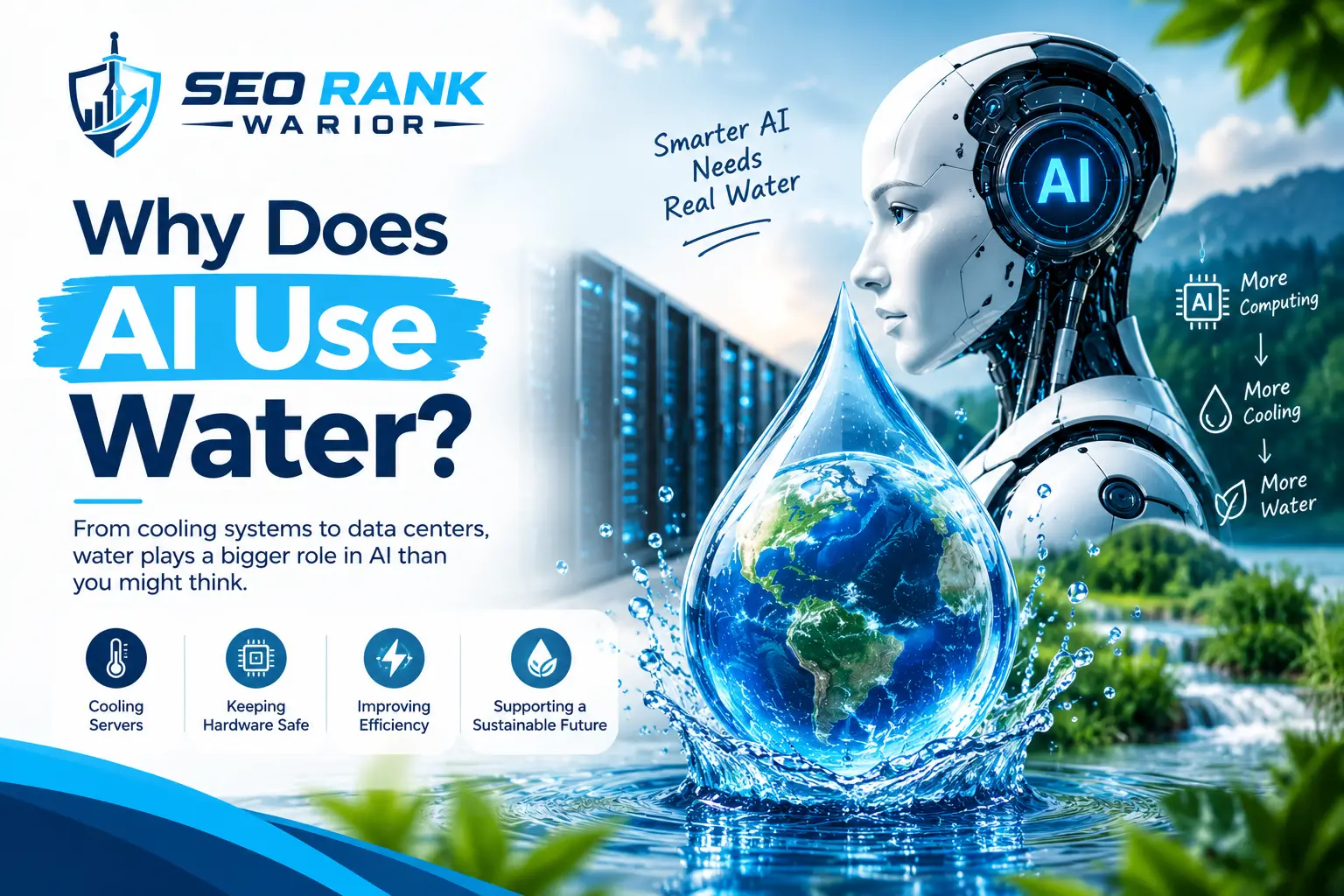
AI itself does not consume water in the way a person or machine might. The water is mainly connected to the data centers and infrastructure that run AI systems.
AI models run on powerful processors such as GPUs and other specialized chips. These components generate a significant amount of heat when they perform calculations. Data centers need to remove that heat continuously to keep the equipment operating safely.
One common method is evaporative cooling. In these systems, water helps remove heat, and some of it evaporates into the atmosphere.
AI has more than one water footprint.
When researchers calculate AI’s water use, they may consider several sources:
1. Direct cooling water
This is the water used at the data center to cool servers and other equipment.
2. Water used to generate electricity
Power plants can also require water, meaning the electricity used by AI can have an indirect water footprint.
3. Semiconductor manufacturing
The production of advanced chips requires water as well, adding another layer to AI’s overall environmental footprint.
Because different studies include different parts of this chain, their final estimates can vary substantially.
How Much Water Does One AI Query Use?
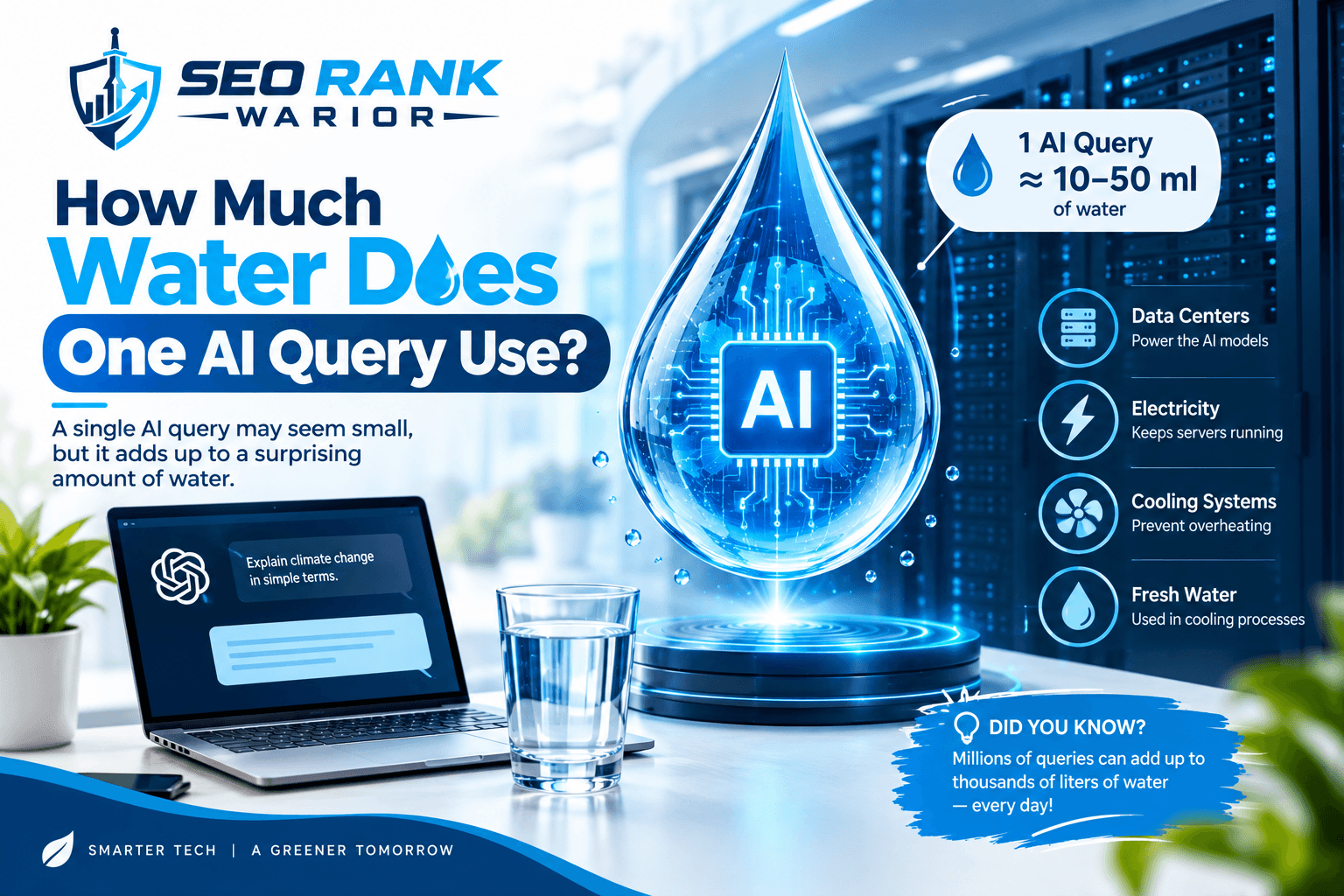
This is probably the question most people are interested in, but it is also one of the easiest to oversimplify.
A short text question can have a relatively small water footprint. However, an AI system answering a complex reasoning request or generating an image may require significantly more computing power than a simple text response.
Google’s analysis provides one useful example. It estimated that a median Gemini text prompt used around 0.26 milliliters of water under its broader methodology. A narrower calculation that focused on active TPU and GPU consumption came to about 0.12 milliliters.
These numbers demonstrate an important point: the water cost of an AI query depends on what you include in the calculation.
A simple AI prompt is not the same as a heavy AI task
Consider the difference between these requests:
- “What is the capital of France?”
- “Write a 2,000-word research report.”
- “Analyze this 100-page document.”
- “Generate a detailed AI image.”
- “Create and edit a high-resolution video.”
They all use AI, but they do not require the same amount of computation. More demanding workloads generally require more processing, which can increase energy use and the associated environmental footprint.
Why Are AI Water Estimates So Different?

If you’ve seen different numbers online, you’re not imagining the contradiction. Researchers are often measuring different things.
Different AI models
Not every AI model requires the same amount of computing power. Smaller models can often complete straightforward tasks using fewer resources, while larger models may require substantially more computation.
Different workloads
A short text response is usually less computationally demanding than image generation, video generation, or advanced reasoning.
Different data centers
Climate and geography matter. A data center in a cool region may have different cooling requirements from one operating in a hot climate.
Water availability also matters. Using the same amount of water in a water-rich region is not necessarily equivalent to using it in a drought-prone area.
Different cooling technologies
Data centers can use different approaches to remove heat, including:
- Evaporative cooling
- Air cooling
- Liquid cooling
- Direct-to-chip cooling
- Closed-loop cooling systems
Each technology can have a different water footprint.
Different measurement methods
Researchers may measure water withdrawal or water consumption, and these terms are not interchangeable.
Water withdrawal refers to the amount of water taken from a source. Water consumption generally refers to the portion that is not returned to the same water system during the relevant period.
That distinction can significantly affect the final number.
How Much Water Do AI Data Centers Use?
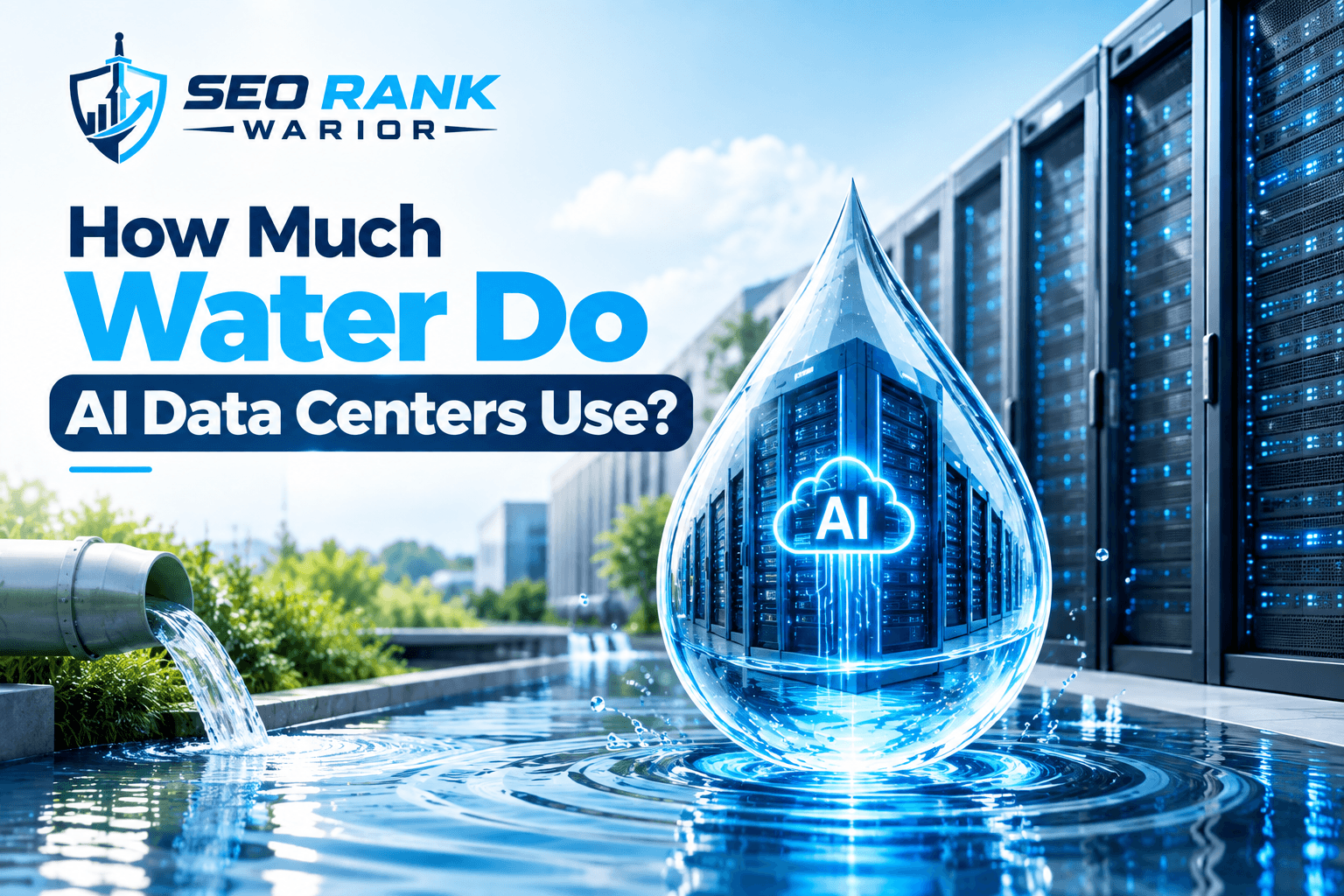
The individual prompt is only one part of the story. The larger issue becomes easier to understand when we look at entire data centers.
According to research from Lawrence Berkeley National Laboratory, U.S. data centers consumed approximately 17.4 billion gallons of water directly in 2023. This figure covers data centers generally rather than AI alone, but AI is becoming an increasingly important driver of data-center growth.
Why is AI increasing the pressure?
Modern AI systems require large amounts of computing power. As companies deploy more advanced models, they need more servers and specialized processors.
That creates several infrastructure demands:
- More computing capacity
- More electricity
- More cooling
- More data-center construction
- Potentially more water consumption
A 2026 study estimated that U.S. data centers could require around 697 million to 1.451 billion gallons of additional water capacity per day by 2030, depending on growth and efficiency assumptions.
The important point is that the environmental impact becomes much more significant when millions or billions of AI requests are processed at scale.
What Is AI’s Global Water Footprint?
The global picture is even more difficult to calculate because AI infrastructure is spread across different countries, climates, power systems, and cooling technologies.
A 2026 study published in Water Research projected that AI’s global water footprint could reach approximately 4.2 to 6.6 billion cubic meters annually by 2027.
That is a much bigger figure than the water used by an individual prompt, but it should not be interpreted as a precise metric that tracks every AI request around the world.
Why the global estimate is difficult
There are several challenges:
- AI companies do not always publish detailed facility-level water data.
- Different studies use different accounting boundaries.
- Data-center locations have different cooling requirements.
- Electricity sources have different water footprints.
- AI workloads change rapidly as models become more capable.
For this reason, global estimates should be viewed as projections rather than an exact real-time measurement.
Does AI Training Use More Water Than AI Inference?

There are two major stages to consider: training and inference.
Training is when a model learns from enormous amounts of data before it becomes available to users. Inference happens when the trained model generates an answer after receiving a prompt.
AI training
Training can involve thousands of processors running for long periods. This can create a substantial energy and cooling requirement.
A widely cited estimate suggested that training GPT-3 consumed roughly 700,000 liters of freshwater.
AI inference
Inference happens every time users interact with an AI model. One request may have a small footprint, but the number of requests can become enormous when a service is used by millions of people.
This creates an important distinction:
Training can have a large upfront environmental footprint, while inference creates a continuing footprint as people keep using the model.
As AI adoption grows, both sides matter.
Does AI Use More Water Than Other Digital Activities?
It is difficult to make a simple comparison because “digital activity” covers many different things.
Watching a video, using a search engine, storing files in the cloud, sending messages, and generating an AI image all require different amounts of computing resources.
The better question is not simply whether AI uses “more” or “less” water than another digital service. Instead, researchers can compare:
- Water consumption per unit of computing
- Water consumption per unit of energy
- Total data-center water consumption
- Water consumption during peak demand
- Water stress in the location where the data center operates
This broader approach gives a more realistic picture of AI’s environmental impact.
What Is Water Usage Effectiveness (WUE)?

One useful metric for understanding data center water efficiency is Water Usage Effectiveness (WUE).
WUE measures how much water a data center consumes compared with the energy used by its IT equipment. In simple terms, it helps operators understand how efficiently a facility is using water for cooling.
A lower WUE generally means less water is being consumed relative to the computing work being performed.
Why WUE matters for AI
As AI data centers become more powerful, operators have an incentive to improve cooling efficiency. Better WUE can help reduce:
- Freshwater consumption
- Cooling costs
- Pressure on local water supplies
- The environmental impact of large computing facilities
However, WUE alone does not tell the whole story. A data center can have efficient water usage while still being located in an area where water is already scarce.
How Can AI Reduce Its Water Consumption?
Reducing AI’s water footprint will require changes in both software and data-center infrastructure.
More efficient AI models
Smaller and better-optimized models can sometimes perform useful tasks with fewer computational resources.
Techniques such as model optimization, quantization, and more efficient inference can reduce the amount of processing required.
Better cooling systems
Data centers can invest in cooling technologies that use less freshwater, including:
- Closed-loop cooling
- Direct-to-chip liquid cooling
- Air-based cooling
- More efficient heat-rejection systems
The best solution depends on the facility, climate, hardware, and local infrastructure.
Smarter data-center locations
Location is one of the most important factors.
Building a large AI facility in an area with abundant water may create less local pressure than building the same facility in a water-stressed region.
Companies therefore need to consider water availability when selecting locations, not just electricity prices and network connectivity.
Greater transparency
AI companies and data-center operators can also improve reporting.
More detailed information about:
- Water consumption
- Cooling technology
- Data-center location
- Peak water demand
- Water sources
would make it easier for researchers, governments, and communities to understand the real impact.
Should You Stop Using AI Because It Uses Water?
For most people, there is no need to think of every AI prompt as an environmental disaster.
A single ordinary text request can have a very small water footprint. The bigger concern is what happens when AI systems are used at enormous scale, and the infrastructure supporting them is concentrated in areas where water resources are limited.
In other words, the question should not only be “How much water does my AI prompt use?”
It should also be:
“How are AI companies managing the water and energy needs of the infrastructure serving millions of users?”
That shift in perspective makes the issue much easier to understand.
FAQs – How Much Water Does AI Use?
How much water does AI use per question?
There is no universal figure. Some recent provider-specific estimates put a typical text prompt below one milliliter, while broader studies can produce higher estimates depending on the methodology, workload, cooling system, and location.
Why does AI need water?
AI data centers generate heat while powerful processors perform calculations. Water can be used in cooling systems to remove that heat. Additional water may also be associated with electricity generation and chip manufacturing.
Does ChatGPT use water?
AI services such as ChatGPT have an associated water footprint because they operate on data-center infrastructure that requires electricity and cooling. However, there is no single water-use number that applies to every ChatGPT request.
Which AI uses the least water?
There is no permanent ranking. Smaller, more efficient models generally require fewer computational resources, but actual water use also depends on the data center, cooling technology, workload, and electricity source.
Is AI water consumption a serious environmental issue?
It can become a serious issue, particularly when large data centers operate in water-stressed regions. The main concern is the cumulative demand created by rapidly expanding AI infrastructure rather than the tiny water footprint of one ordinary text prompt.
Conclusion
AI does use water, but there is no single number that applies to every AI query. A simple text prompt may use only a fraction of a milliliter under some measurement methods, while larger workloads and broader accounting can produce much higher estimates. As AI continues to expand, the real challenge will be managing data-center cooling, water availability, energy use, and infrastructure growth responsibly—especially in regions where freshwater resources are already under pressure.