
Cyberattacks can affect almost every part of a modern organization, from customer data and employee accounts to cloud systems and critical business applications. A cybersecurity analyst helps reduce that risk by monitoring systems, investigating suspicious activity, identifying vulnerabilities, and responding to security incidents before they can cause greater damage.
The role combines technical knowledge with analytical thinking and problem-solving. Depending on the organization, a cybersecurity analyst may spend part of the day reviewing security alerts, analyzing logs, investigating phishing attempts, assessing vulnerabilities, or working with other teams to strengthen security controls. In 2026, the role is also expanding as organizations deal with cloud environments, AI-related risks, supply-chain exposure, and increasingly automated attacks.
What Is a Cybersecurity Analyst?
A cybersecurity analyst is a security professional who helps protect an organization’s networks, systems, applications, devices, and data from cyber threats. Their work generally involves detecting suspicious activity, investigating security events, assessing vulnerabilities, and supporting incident response.
The exact job can look different from one organization to another. In a smaller company, one analyst might handle several areas of security. In a large enterprise, analysts may specialize in areas such as security operations, threat detection, vulnerability management, cloud security, or incident response.
The distinction is important because a job title does not always describe every responsibility. NIST’s NICE Framework uses work roles to describe groups of cybersecurity tasks, knowledge, and skills, and notes that one job can include multiple work roles.
In simple terms, a cybersecurity analyst helps answer three important questions:
- Is something suspicious happening?
- What happened and how serious is it?
- What should the organization do about it?
That makes the role an important part of a modern security team.
What Does a Cybersecurity Analyst Do?

The daily responsibilities of a cybersecurity analyst depend on the organization’s size, industry, technology environment, and security maturity. However, several responsibilities are common across the profession.
Monitor Networks and Systems for Threats
Analysts monitor network traffic, endpoints, authentication events, applications, and other systems for signs of suspicious behavior. Security monitoring may generate a large number of alerts, so analysts need to determine which events are routine and which could represent genuine threats.
This often involves working with security information and event management (SIEM) platforms, endpoint detection and response tools, network monitoring systems, and other security technologies.
Investigate Security Alerts and Incidents
An alert does not automatically mean an organization has been breached. Analysts investigate the available evidence to determine what happened.
They may examine login activity, IP addresses, timestamps, system logs, endpoint behavior, email activity, or other relevant information. The goal is to establish whether an event is malicious, understand its scope, and determine what action is required.
Identify and Assess Vulnerabilities
A cybersecurity analyst may participate in vulnerability assessments and help identify weaknesses in systems, applications, devices, or configurations.
Finding a vulnerability is only part of the process. Analysts also need to consider its severity, exploitability, affected assets, and business importance so that security teams can prioritize remediation.
Manage Security Tools and Controls
Depending on the role, analysts may configure, maintain, monitor, or evaluate security technologies such as firewalls, endpoint protection, intrusion detection systems, encryption tools, vulnerability scanners, and identity controls.
The objective is not simply to operate security software. Analysts need to understand whether those controls are working effectively and whether they are generating useful security information.
Analyze Logs and Security Data
Logs provide evidence about what happened across an organization’s environment. Analysts may review authentication records, network events, application logs, endpoint activity, and cloud events to identify patterns that could indicate an attack.
Strong log analysis requires attention to detail because an individual event may appear harmless until it is connected with several other events.
Respond to Cybersecurity Incidents
When a confirmed incident occurs, the cybersecurity analyst may support containment, investigation, eradication, and recovery.
The analyst may isolate an affected account or device, collect evidence, identify related activity, escalate the incident, and help verify that the threat has been removed.
Document Findings and Prepare Reports
Documentation is another important responsibility. Analysts need to record what happened, what evidence was found, what actions were taken, and what recommendations should follow.
Clear documentation also helps other security professionals understand incidents and identify patterns over time.
Support Security Testing and Improvements
Analysts may participate in vulnerability testing, penetration testing, security assessments, configuration reviews, or other activities designed to identify weaknesses.
Their findings can help organizations improve controls before an attacker exploits a weakness.
APMG similarly identifies monitoring, threat analysis, vulnerability identification, incident response, penetration testing, reporting, security training, and collaboration among important cybersecurity analyst responsibilities.
What Does a Cybersecurity Analyst Do Every Day?
There is no single routine that applies to every analyst, but a typical workday may involve a combination of monitoring, investigation, communication, and documentation.
A morning shift in a security operations environment might begin by reviewing overnight alerts and incidents. The analyst may prioritize events based on severity and investigate anything that appears unusual.
During the day, the analyst could investigate a suspicious login, review a phishing report, examine endpoint activity, or help a system administrator remediate a vulnerability.
Some days may be relatively quiet. Others can become much more demanding when a significant security incident occurs.
A practical workflow might look like this:
- Review security alerts and open incidents.
- Identify events requiring investigation.
- Examine logs and related security data.
- Determine whether suspicious behavior represents a genuine threat.
- Escalate or contain confirmed incidents.
- Document findings and actions.
- Check vulnerabilities or security-control issues.
- Communicate important findings to relevant teams.
- Recommend improvements where weaknesses are identified.
This combination of technical investigation and decision-making is what makes the cybersecurity analyst role different from simply monitoring a dashboard.
Why Is a Cybersecurity Analyst Important?
Organizations collect and process enormous amounts of information, and their systems are increasingly connected to employees, customers, vendors, cloud platforms, applications, and third-party services.
A cybersecurity analyst helps provide an active layer of defense against this complexity.
Early detection can reduce the potential impact of an incident. Effective investigation can reveal how an attack occurred and whether other systems were affected. Vulnerability analysis can help organizations address weaknesses before they are exploited.
The role also contributes to trust. Customers and business partners expect organizations to take reasonable steps to protect sensitive information and maintain reliable systems.
In practice, cybersecurity analysts help organizations move from a reactive approach—responding only after something goes wrong—to a more continuous process of monitoring, detection, investigation, and improvement.
Key Skills Every Cybersecurity Analyst Needs
A strong analyst needs both technical and professional skills. Tools can automate parts of security monitoring, but people still need to interpret evidence and make decisions.
Network Security
Understanding networks helps analysts recognize unusual traffic, suspicious connections, unauthorized access, and other indicators of compromise.
Basic knowledge of protocols, firewalls, DNS, VPNs, routing, and network segmentation can be particularly useful.
Threat Detection and Analysis
Analysts need to understand common attack techniques and how suspicious behavior may appear in security data.
Knowledge of threat intelligence and attacker tactics can help analysts distinguish routine activity from potentially malicious behavior.
SIEM and Log Analysis
SIEM platforms can collect and correlate security events from different systems. Analysts need to understand how to search, filter, correlate, and interpret those events.
The technology is valuable, but the analyst’s ability to ask the right questions is equally important.
Endpoint Security
Endpoints such as laptops, servers, and mobile devices can become entry points for attackers. Analysts should understand endpoint protection, suspicious processes, malware indicators, and device isolation.
Vulnerability Management
Analysts should understand how vulnerabilities are identified, assessed, prioritized, and remediated. They also need to understand that the most technically severe vulnerability is not necessarily the organization’s highest business risk.
Incident Response
Incident response requires a structured approach to detection, containment, investigation, recovery, and lessons learned.
An analyst should know when to investigate independently and when to escalate an incident to senior responders or specialized teams.
Cloud Security
As organizations move workloads and data into cloud environments, analysts increasingly need familiarity with cloud identities, permissions, configurations, logging, and security monitoring.
Basic Programming and Scripting
Programming is not required at the same depth for every analyst position, but scripting can make repetitive security tasks more efficient.
Python, PowerShell, shell scripting, and other automation skills can help with log processing, data analysis, investigation, and routine security operations.
Critical Thinking and Attention to Detail
Security investigations often involve incomplete information. Analysts need to form hypotheses, test them against evidence, and avoid jumping to conclusions.
Attention to detail is particularly important because a small clue—such as an unusual login location or unexpected process—can become significant when combined with other evidence.
Communication
An analyst may need to explain a technical issue to a system administrator, manager, developer, or executive.
Being able to communicate what happened, why it matters, and what action is recommended is therefore a valuable professional skill.
What Tools Does a Cybersecurity Analyst Use?
The exact technology stack varies between organizations, but common categories include:
- SIEM platforms for collecting and correlating security events
- EDR tools for monitoring and responding to endpoint activity
- Firewalls for controlling network traffic
- Intrusion detection and prevention systems for identifying suspicious network behavior
- Vulnerability scanners for finding security weaknesses
- Threat intelligence platforms for understanding current threats
- Network monitoring tools for analyzing traffic and system activity
- Identity and access tools for monitoring accounts and permissions
- Ticketing and incident-management platforms for tracking investigations
- Packet-analysis tools for examining network communications
A good cybersecurity analyst does not simply know the names of these tools. They understand what type of security problem each tool helps solve and how its output fits into an investigation.
Cybersecurity Analyst vs Information Security Analyst
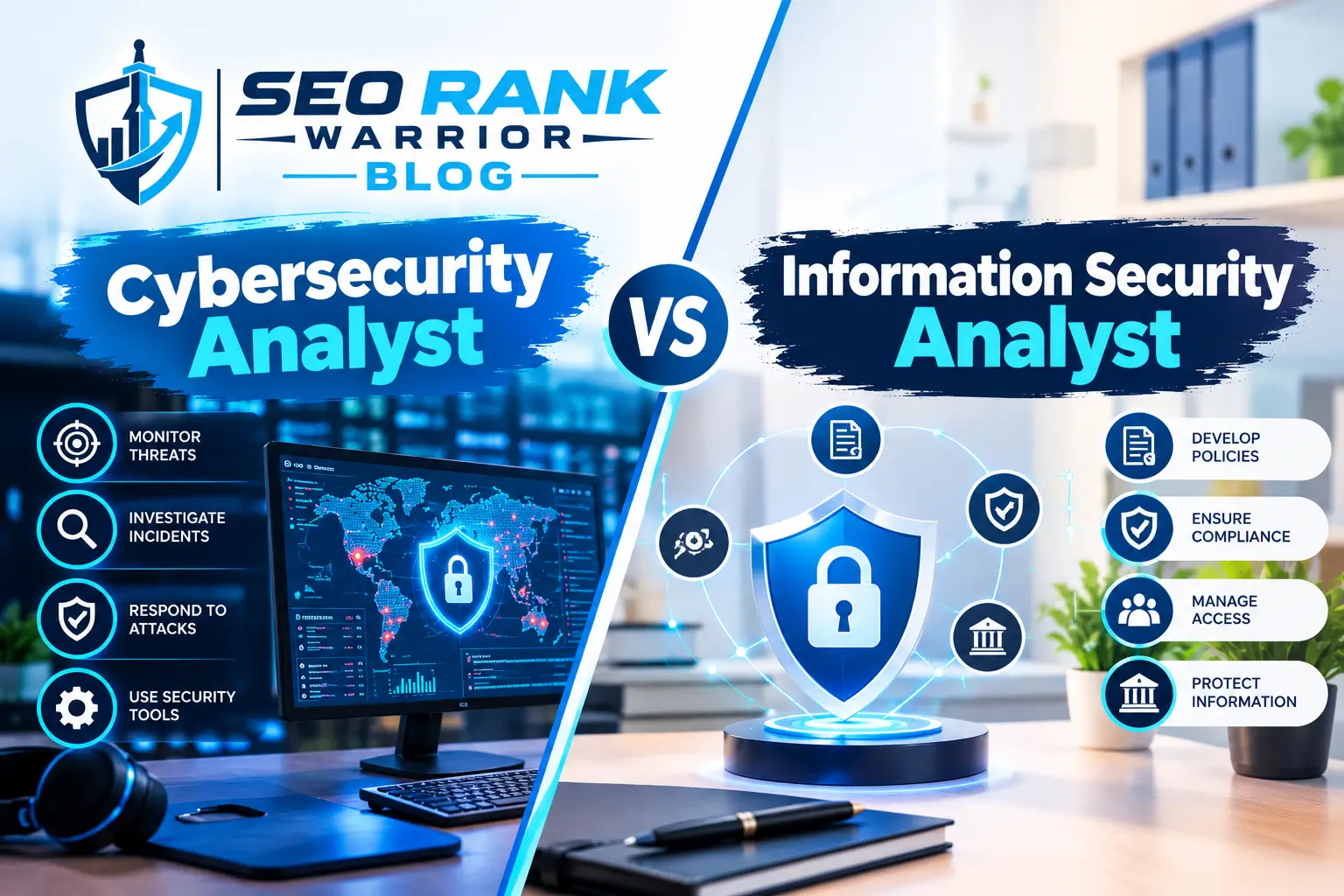
The terms cybersecurity analyst and information security analyst are sometimes used interchangeably, and many employers use them differently.
A cybersecurity analyst often has a stronger focus on technical threats, security monitoring, detection, investigation, and incident response.
An information security analyst may have a broader information-protection role that includes security controls, policies, risk assessments, compliance, data protection, and organizational security practices.
There is considerable overlap. The actual job description is more important than the title.
This is consistent with the broader NICE approach, where cybersecurity work is organized around responsibilities and capabilities rather than assuming every organization uses identical job titles.
Cybersecurity Analyst vs Cybersecurity Engineer
A cybersecurity engineer generally focuses more heavily on designing, implementing, and maintaining security infrastructure.
A cybersecurity analyst is more commonly focused on monitoring, detection, investigation, and response.
For example, a security engineer might design a secure network architecture or implement an endpoint security platform, while an analyst may monitor that environment, investigate alerts, and determine whether suspicious activity indicates an attack.
The two roles often work closely together. Analysts can identify weaknesses or recurring threats, while engineers can use those findings to improve technical defenses. APMG also distinguishes security engineers as professionals who focus on designing, implementing, and maintaining secure solutions, while analysts primarily monitor and respond to security events.
Cybersecurity Analyst vs Cybersecurity Consultant
A cybersecurity consultant usually provides security expertise to organizations as an external adviser or service provider.
Consultants may perform security assessments, audits, penetration tests, risk assessments, architecture reviews, or strategic projects for multiple clients.
A cybersecurity analyst, by comparison, is often embedded within an organization’s security operations and focuses on its ongoing security environment.
However, the boundary can overlap. An analyst can work for a consulting or security services company, and a consultant may perform analytical security work.
Cybersecurity Analyst vs Cybersecurity Specialist
A cybersecurity specialist is a broad title that can refer to professionals working in a particular security area. Depending on the employer, a specialist might focus on endpoint security, cloud security, identity, compliance, vulnerability management, or another domain.
A cybersecurity analyst is generally associated more closely with security analysis, monitoring, investigation, and response.
Because these titles are not standardized across every employer, candidates should evaluate the responsibilities, required skills, and tools listed in the actual job description.
How to Become a Cybersecurity Analyst
There is no single path into the profession. A practical route can include the following steps.
1. Learn IT and Cybersecurity Fundamentals
Start with operating systems, networking, authentication, common attack methods, security controls, and basic risk concepts.
2. Build Networking and Security Skills
Learn how networks operate and how security technologies protect them. Practice reading logs and understanding common security events.
3. Practice With Realistic Labs and Projects
Hands-on practice is valuable. Build a small lab, investigate simulated attacks, analyze logs, practice vulnerability assessment, or work through incident-response scenarios.
4. Learn Industry Security Tools
Gain familiarity with SIEM, endpoint security, vulnerability scanning, network monitoring, and other technologies used by security teams.
5. Consider Relevant Certifications
Certifications can provide structured learning and demonstrate knowledge. Depending on career goals, options can include CompTIA Security+, CompTIA CySA+, ISC2 Certified in Cybersecurity, or other role-appropriate credentials.
6. Build Practical Experience
Entry-level IT, networking, help-desk, system administration, or security internships can provide useful experience. Not every analyst begins with a cybersecurity job title.
7. Apply for Junior and Entry-Level Roles
Look for positions such as junior cybersecurity analyst, SOC analyst, security operations analyst, or related entry-level security roles.
NIST’s NICE Framework can also help candidates understand the knowledge and skills associated with different cybersecurity work roles and career pathways.
Do You Need a Degree to Become a Cybersecurity Analyst?
A degree can be helpful, particularly for employers that prefer formal education in computer science, cybersecurity, information technology, information systems, or a related field.
However, requirements vary. Practical experience, technical skills, certifications, projects, internships, and demonstrated problem-solving ability can also matter.
Someone transitioning from IT or networking may already have useful experience that can be developed into cybersecurity expertise.
The key is to build evidence that you can actually perform security work—not simply collect credentials.
Which Certifications Can Help a Cybersecurity Analyst?
Certifications should support a career strategy rather than replace practical experience.
For beginners, CompTIA Security+ can provide a broad security foundation. More security-focused professionals may consider CompTIA CySA+, while ISC2’s Certified in Cybersecurity (CC) can provide another entry-level credential.
More advanced certifications may become relevant as a professional moves toward specialized or leadership positions.
The best choice depends on current experience, target job descriptions, employer expectations, and the area of cybersecurity the person wants to pursue.
Cybersecurity Analyst Career Path
A cybersecurity career does not always follow a straight ladder.
One possible path is:
IT Support or Networking → Junior Cybersecurity Analyst → Cybersecurity Analyst → Senior Cybersecurity Analyst → Specialized or Leadership Role
From there, professionals may move into areas such as:
- Threat hunting
- Incident response
- Security engineering
- Digital forensics
- Cloud security
- Vulnerability management
- Security architecture
- Cybersecurity consulting
- Security management
NIST emphasizes that cybersecurity work roles are not necessarily the same thing as job titles, and a single job can contain multiple work roles. That flexibility is useful when planning a career because professionals can develop skills across several areas rather than following one fixed path.
Cybersecurity Analyst Salary and Job Outlook
Salary depends heavily on location, experience, specialization, industry, and employer. For that reason, a single global salary figure can be misleading.
The broader U.S. information-security occupation has strong employment demand. Current career guidance from Coursera, updated in August 2026, cites U.S. Bureau of Labor Statistics data and reports a 29% projected growth rate for information security analysts from 2024 to 2034, with about 16,000 openings projected annually.
Actual opportunities for cybersecurity analysts can vary by title because employers use different names for similar responsibilities. Candidates should therefore search across related titles rather than relying on one exact phrase.
Where Can Cybersecurity Analysts Work?
Cybersecurity analysts can work in almost any industry that depends on digital systems.
Common environments include:
- Technology companies
- Banks and financial institutions
- Healthcare organizations
- Government agencies
- E-commerce businesses
- Telecommunications companies
- Manufacturing
- Universities
- Consulting firms
- Managed security service providers
- Large enterprises
Some analysts work directly for one organization, while others work for security providers and support multiple clients. APMG distinguishes internal analysts from external analysts who may work through security firms or consultancy arrangements.
How the Cybersecurity Analyst Role Is Changing in 2026
Cybersecurity analysis is becoming more specialized and more closely connected to automation, cloud infrastructure, AI, and supply-chain risk.
AI-assisted security operations can help analysts process large volumes of alerts, identify patterns, summarize evidence, and prioritize investigations. At the same time, analysts need to understand the risks created by AI-enabled attacks and the use of AI systems within their own organizations.
Cloud and identity security are also increasingly important. Modern environments may include multiple cloud platforms, remote users, SaaS applications, APIs, and machine identities. This means analysts need to understand security beyond traditional corporate networks.
Supply-chain risk is another growing area. In April 2026, NIST’s NICE Framework Components v2.2.0 introduced a dedicated Cybersecurity Supply Chain Risk Management work role and updated competency areas for cryptography and DevSecOps.
The same update reinforces a broader trend: cybersecurity professionals increasingly need skills that connect security with software development, cloud environments, supply chains, resilience, and emerging technology.
For analysts, this means the job is becoming less about watching a screen for alerts and more about understanding context, connecting evidence, automating repetitive work, and helping organizations respond intelligently to risk.
A Practical Example of a Cybersecurity Analyst Responding to a Threat
Imagine an employee receives a convincing phishing email and enters their credentials on a malicious website.
A security platform detects an unusual login from an unfamiliar location. The cybersecurity analyst reviews authentication logs and discovers that the account was accessed shortly after the phishing message was delivered.
The analyst investigates whether the account accessed sensitive resources. If compromise is confirmed, the account may be temporarily disabled, credentials reset, sessions revoked, and additional authentication protections enforced.
The investigation does not stop there. The analyst checks whether the attacker accessed other systems, searches for related indicators, documents the incident, and works with the appropriate teams to remove the underlying threat.
Afterward, the organization may improve email filtering, strengthen authentication controls, update detection rules, and provide targeted security awareness training.
This example shows why cybersecurity analysis requires more than identifying an alert. The analyst must connect evidence, assess risk, take action, and help prevent the same problem from happening again.
FAQs – Cybersecurity Analysts
What does a cybersecurity analyst do?
A cybersecurity analyst monitors systems and networks, investigates suspicious activity, identifies vulnerabilities, responds to security incidents, analyzes security data, and helps improve an organization’s security controls.
What skills do you need to become a cybersecurity analyst?
Important skills include networking, threat detection, log analysis, SIEM, endpoint security, vulnerability management, incident response, cloud security, scripting, critical thinking, attention to detail, and communication.
Do you need a degree to become a cybersecurity analyst?
Not always. Some employers prefer a degree in cybersecurity, computer science, information technology, or a related field, while others place greater emphasis on practical experience, certifications, technical skills, and demonstrated ability.
What is the difference between a cybersecurity analyst and an information security analyst?
The titles often overlap. A cybersecurity analyst may focus more on threat detection, investigation, monitoring, and incident response, while an information security analyst may have a broader focus on information protection, security controls, policies, risk, and compliance.
Is cybersecurity analyst a good career?
Cybersecurity analyst can be a strong career option for people who enjoy technology, investigation, problem-solving, and continuous learning. The field continues to evolve as organizations face new threats, cloud complexity, AI-related risks, and supply-chain challenges.
Conclusion
A cybersecurity analyst plays an important role in protecting modern organizations from digital threats. The job combines continuous monitoring with investigation, vulnerability management, incident response, security tools, documentation, and collaboration.
The role can also provide a strong foundation for broader cybersecurity careers. With experience, an analyst can specialize in areas such as threat hunting, incident response, cloud security, digital forensics, security engineering, or cybersecurity consulting.
In 2026, the profession is evolving beyond traditional network monitoring. AI, cloud infrastructure, automation, software security, and supply-chain risk are changing what security teams need from analysts. Building strong fundamentals while continuously developing practical and analytical skills can therefore help cybersecurity professionals remain valuable as the threat landscape changes.