
Time management is the practice of deciding in advance how you will spend your available time so that the most important work gets done. It involves setting priorities, planning tasks, and giving each one a realistic amount of time.
If you have ever wondered what is time management really means beyond “being organized,” this guide explains it clearly. You will find the definition, how the process works, the main principles and techniques, common mistakes, and practical steps for improving your time management skills.
What Is Time Management?
Time management is the process of planning and controlling how much time you spend on specific activities, so you can work more effectively and meet your goals and deadlines.
It is not about squeezing more hours into the day. Everyone has the same 24 hours, and no schedule can change that. Time management is about making intentional choices with the time you do have: what to do first, what to postpone, what to delegate, and what to leave out entirely.
Good time management combines three things: knowing what matters (prioritization), knowing when you will do it (scheduling), and knowing how long it will take (estimation). Remove any one of these and the system usually breaks down.
Why Is Time Management Important?

Without a plan, your day tends to be decided by whatever is loudest: the newest email, the latest message, or the task that feels easiest. Urgent but minor requests crowd out important, long-term work.
Managing time effectively changes that in practical ways:
- Clearer priorities. You know which tasks deserve your best hours and which can wait.
- Fewer missed deadlines. Work is planned backward from the due date instead of started at the last minute.
- Better focus. Fewer decisions about “what next” mean less mental switching.
- Less wasted time. Gaps, delays, and unplanned interruptions become easier to spot.
- Less procrastination. Breaking work into scheduled steps makes starting easier.
- More control over workload. You can see when you are overcommitted before it becomes a crisis.
How Does Time Management Work?
Most time management approaches follow the same basic cycle, even when the techniques differ.
- Identify tasks and responsibilities. List everything you need to do: work projects, study tasks, errands, and recurring commitments. You cannot manage what you have not captured.
- Set priorities. Decide what is most important and most time-sensitive. Not every item deserves equal attention.
- Estimate how long tasks will take. Give each task a rough time. Estimating is a skill that improves with practice.
- Plan and schedule the work. Place tasks into specific days and time slots, matching demanding work to the hours when you focus best.
- Focus on important tasks. During your scheduled time, work on one thing and limit interruptions.
- Review progress and adjust. At the end of the day or week, check what got done, what did not, and why. Then adjust the next plan.
The last step matters most. A plan that never gets reviewed cannot improve.
Key Principles of Time Management
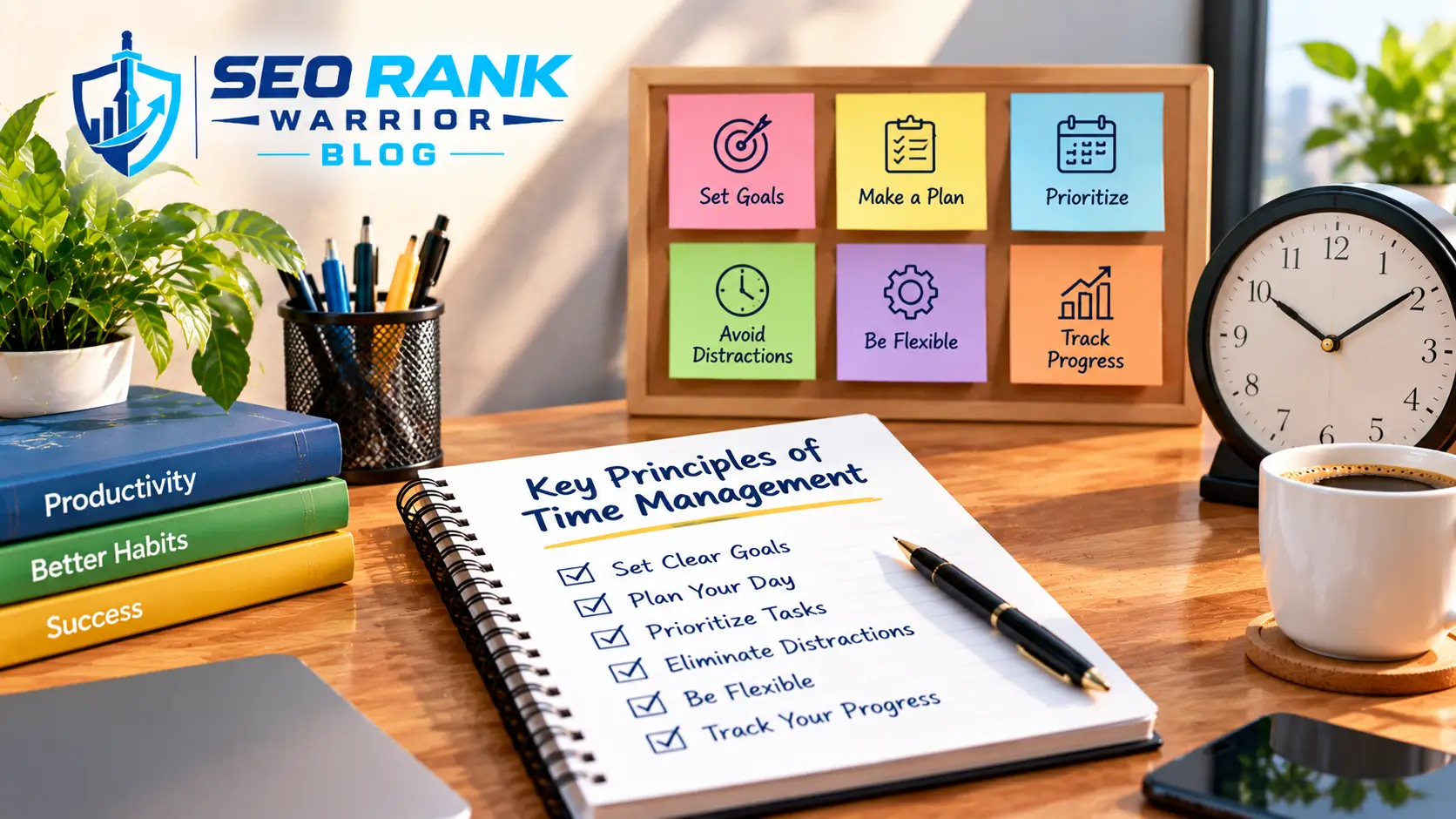
Techniques come and go, but a few principles hold up across almost every system.
Prioritize Important Tasks
Urgent and important are not the same thing. A ringing phone is urgent. Preparing for next month’s presentation is important. Prioritization means protecting time for important work before urgent noise fills the day. A simple daily habit is choosing your top one to three tasks each morning.
Set Clear Goals
Vague goals produce vague schedules. “Work on the report” is hard to schedule. “Write the first two sections of the report by Wednesday” is not. Clear goals tell you what to prioritize and when a task is actually finished.
Plan Your Schedule
Planning turns intentions into commitments. Spend a few minutes at the start of each day or week deciding what goes where. Planning does not need to be elaborate, but tasks without a time slot tend to get pushed aside.
Allocate Realistic Time
Most people underestimate how long tasks take. Base estimates on similar past work, not the best-case scenario. If a report took three hours last time, do not schedule 45 minutes because you wish it would go faster.
Avoid Multitasking
Switching between tasks is not the same as doing them together. Each switch costs mental effort as you reorient yourself. Grouping similar work and finishing one task before starting another usually produces cleaner results.
What Is Time Management?
Real days include delays, longer meetings, and surprises. Leaving gaps between tasks, or keeping part of your day unscheduled, prevents one overrun from wrecking the whole plan.
Review Your Progress
Reviewing shows the gap between what you planned and what happened. Was the estimate wrong, or was the day interrupted? That answer tells you what to change.
Common Time Management Techniques
There is no single best method. Each technique fits certain kinds of work and personalities, and many people combine two or three.
Time Blocking
What it is: Assigning specific tasks to specific blocks on your calendar.
How it works: Instead of keeping a to-do list, you decide that 9:00 to 11:00 is for writing and 2:00 to 3:00 is for email. The calendar becomes your plan.
When it helps: Useful when your work has many competing demands, or when focused tasks keep losing to smaller interruptions.
Pomodoro Technique
What it is: A method developed by Francesco Cirillo that uses short, timed work sessions.
How it works: You work for 25 minutes without interruption, take a 5-minute break, and after four sessions take a longer break.
When it helps: Good for tasks you tend to avoid, or when you struggle to start. The short time frame makes a large task feel manageable.
Eisenhower Matrix
What it is: A decision tool that sorts tasks by urgency and importance.
How it works: Tasks fall into four groups: do now (urgent and important), schedule (important but not urgent), delegate (urgent but less important), and eliminate (neither).
When it helps: Useful when everything feels urgent, and you need a clear way to decide what to handle first.
Task Batching
What it is: Grouping similar tasks and doing them together in one block.
How it works: Rather than checking email every ten minutes, you handle it two or three times a day. The same applies to calls, invoices, or admin work.
When it helps: Helpful for repetitive or shallow tasks that otherwise interrupt deeper work.
The 80/20 Rule
What it is: Based on the Pareto principle, the idea that a small share of your effort often produces most of your results.
How it works: You identify the few tasks that create the most value and give them priority. The ratio is a rough guide, not an exact rule.
When it helps: Useful when your task list is long, and you need to decide where effort matters most.
Time Tracking
What it is: Recording how you actually spend your time.
How it works: For a week or two, you note what you do and for how long, either manually or with an app. Then you compare it with what you thought you were doing.
When it helps: Useful when you feel busy but unproductive, or when your estimates are consistently off.
Benefits of Effective Time Management

The benefits build gradually rather than overnight, and they depend on how consistently you apply the habits.
Good time management can support productivity by directing effort toward the right tasks. It can improve focus by reducing constant switching. It makes deadline management easier because work is spread out instead of compressed. Better organization means fewer forgotten tasks and less last-minute searching.
It can also support work-life balance. When work has defined boundaries, personal time is less likely to be quietly consumed by unfinished tasks. And because planning makes starting easier, it can help reduce procrastination. Time management does not remove stress or guarantee success, but it gives you more control over how you use your time.
Common Time Management Mistakes
Most problems come from a handful of habits.
Overloading the schedule. Filling every hour leaves no room for delays and almost guarantees a plan that fails by midday.
Failing to prioritize. Treating all tasks as equal leads to busy days with little progress on what matters.
Underestimating task duration. Optimistic estimates create schedules that are behind by lunchtime.
Constantly checking notifications. Frequent alerts break concentration and make deep work difficult.
Trying to multitask. Splitting attention across tasks usually makes each one slower.
Procrastinating on hard tasks. Delaying difficult work does not remove it. It compresses the time available later.
Not reviewing plans. Without review, the same scheduling errors repeat.
Setting unrealistic deadlines. Deadlines that ignore actual effort create stress and often force lower-quality work.
How to Improve Your Time Management Skills
Improvement comes from small, repeatable habits rather than a complete overhaul.
- Start by observing. For a few days, note where your time goes. You may find that meetings, messages, or unplanned tasks take more than expected.
- Write down all commitments. Keep them in one place so nothing sits only in your memory.
- Choose your top priorities daily. Pick one to three tasks that would make the day successful.
- Schedule those tasks first. Give them protected time, ideally during your best focus hours.
- Use realistic estimates and add buffers. Base timing on experience, and leave space for the unexpected.
- Reduce interruptions. Silence non-essential notifications during focus blocks and check messages at set times.
- Break large tasks into smaller steps. Concrete steps are easier to start and easier to schedule.
- Review weekly. Look at what worked, what slipped, and what needs to change.
Start with one or two of these. Trying to change everything at once often leads to abandoning all of it.
Time Management for Different People
The principles are the same for everyone, but the pressures differ.
Students
Students juggle classes, assignments, exams, and personal life, often with fixed deadlines far apart. Working backward from due dates, splitting big assignments into stages, and scheduling regular study sessions helps prevent last-minute cramming.
Professionals
Employees often face constant meetings and requests. Protecting focus time on the calendar, batching email, and clarifying priorities with a manager help separate real priorities from interruptions.
Freelancers
Freelancers control their own schedules but also carry admin, client communication, and finding new work. Setting working hours, tracking time per project, and reserving space for non-billable tasks keeps work sustainable.
Remote Workers
Remote work removes the natural structure of an office. Clear start and end times, a defined workspace, and scheduled breaks help keep work from spreading across the whole day.
Teams and Businesses
Teams need shared visibility as well as individual habits. Clear ownership, realistic deadlines, and agreed communication rules reduce delays and overlapping work.
Can Productivity Tools Help With Time Management?
Yes, as a support system. Calendars help with scheduling and time blocking. Task managers keep commitments in one place. Time trackers reveal where hours actually go, and focus apps protect concentration.
But software does not decide your priorities for you. A calendar full of poorly chosen tasks is still poorly organized, and a task app does nothing if you never review it. Build the habits first, then choose tools that fit them.
For a broader look at the different categories and how to choose among them, see our guide to productivity tools.
FAQs – What Is Time Management?
What is time management in simple words?
Time management means planning how you spend your time so important tasks get done. It involves setting priorities, scheduling work, and estimating how long tasks will take.
Why is time management important?
It helps you focus on priorities, meet deadlines, reduce wasted time, and stay in control of your workload. Without it, urgent but minor tasks tend to crowd out important work.
What are the main time management techniques?
Common techniques include time blocking, the Pomodoro Technique, the Eisenhower Matrix, task batching, the 80/20 rule, and time tracking. Each suits different types of work, so many people combine a few.
How can I improve my time management skills?
Start by observing where your time goes. Then choose a few daily priorities, schedule them first, use realistic time estimates, reduce interruptions, and review your plan weekly. Small, consistent habits work better than a complete overhaul.
What is the best way to manage time?
There is no single best way, because it depends on your work and habits. A reliable starting point is to prioritize your most important tasks, schedule them into specific time blocks, and review what worked at the end of each week.
Conclusion
Time management is not about doing everything. It is about deciding what matters, giving it realistic time, and reviewing how it went. Start small: choose your top priorities tomorrow morning, schedule them first, and adjust as you learn how your days actually unfold.